Teachinghearts
"Explore the Word. Change the World"
| Teachinghearts |
Church History
"Explore the Word. Change the World" |
|
|---|---|---|
| Home | Contact | Become a Christian | Lessons | 700+ New Messianic Prophecies | Modern Science In The Bible | ||
| Rome |  |
 |
Papal Persecutions | Papal Inquisition | Roman Inquisition | Ecumenism | |||||||
|---|---|---|---|---|---|---|---|---|---|---|---|---|---|
| Roman Persecutions | Europe |  |
France | Albigenses | Waldensians | Hussites | Huguenot | Reformation | Revival | ||||
| Byzantine | Crusades | Spanish Inquisition | French Revolution | ||||||||||
| Paganism | Sabbath | Idols | Rosary | Indulgences |  |
 |
 |
Infallability | |||||
|
||
|
Oh, that you would bless me indeed and enlarge my territory and that your hand would be with me, and that you would keep me from evil, that I may not cause pain. The prayer of Jabez (I Chronicles 4:10) |
History from Creation to the Exodus
Several chronologies have been proposed in order to estimate how many years have gone by since creation.
To a large extent, most chronologies agree to the exact year up to the time of the Exodus, thereafter discrepancies amounting to a maximum of 300+ years creep into the
chronology because the history of families was not as well catalogued. This is in part due to the break up of the continuity of the lineages because of Israel's
captivity by a series of nations. Indeed, it is at this point that we see God giving visions of the domination of his people
by these nations that is the focus of this study.
World Empires in Prophecy
It is important to note that when the prophecies speak about empires, it is only concerned with empires that challenge God's people by their power.
Although Egypt and Assyria captured the people of God, the symbolic prophecies begin with the invasion of Babylon.

| Empires in Prophecy | Other Civilizations | ||
|---|---|---|---|---|
| Babylon | The first Empire was the head of gold. | Zhou dynasty in China. They and the rest of the world were tribal | ||
| Medo-Persia | The second Empire (Medes and then Persians under Cyrus the Great) was the chest of silver. | |||
| Greece | The third Empire under Alexander the Great was the belly and thighs of brass. | Qin Dynasty. Vikings invade Russia | ||
| Rome (Pagan) | Under the caesars - The fourth empire was the legs of Iron. They killed the Messiah | Han Dynasty. Maya, Nazca and Hopewell civilizations begin | ||
| Rome (papal) | One phase of the Roman Empire with domination of the state by the church for 1260 years. | Sui, Tang, Xia and Jin dynasties. Sassanians, Umayaads, Abbasida. Gupta in India. Maya and Pueblo | ||
| Europe | The fifth power was the divided European nations which will exist until the end of time. They will not be united as one nation. | |||
| France | The sixth power was short lived during the French Revolution, but its secular ideas would last till the end and challenge faith in God. | British, French, Spanish, Portuguese empires See a Map | ||
| United States | The final power will be a worldwide movement at the end, dominated by the United States of America, the churches and Europe. | Modern nations | ||
| Kingdom of God | The last empire will be the kingdom of God - The stone that shatters the image. | |||
History of the Church
The history of the church included many significant events:
The Conversion of Emperor Constantine
The organized Roman persecution of the Christian church ended with the conversion of the Roman Emperor Constantine.
Constantine became the western emperor after the death of his father, and after Diocletian and Maximian retired.
During a battle outside rome in 312 A.D. , he had a dream in which he saw the sign of the cross in the sky,
with the words In hoc signo vinces which means by this sign conquer.
The next day he added this sign to the standards of his army, and won the battle.
He entered Rome and became unchallenged as western Emperor.
Although he did not convert immediately, from this time forward he began to favor Christianity by his legislation.
He and his mother, Helena, who had also converted to Christianity, spent large sums of money building new churches and visiting the Holy Land.
He was baptized close to the end of his life and died on May 22, 337 A.D.
Legislation of Christianity by the State of Rome
Following are some of the legislation that favored Christianity:
History Of Pagan Influences On Christianity
| History of Changes | |
|---|---|
| Year | History |
| 585 | Strict Sunday worship (second Synod of Macon) |
| 593 | Purgatory |
| 600 | Prayers to saints and Mary |
| 750 | Pope speaks for God |
| 788 | Worship of images, relics, cross |
| 995 | Canonization of dead saints |
| 1050 | Mass |
| 1090 | Rosary |
| 1190 | Indulgences |
| 1215 | Transubstantiation |
| 1215 | Priest confession |
| 1229 | Bible forbidden |
| 1545 | Tradition above the Bible |
| 1546 | Apocrypha added to the Bible |
| 1870 | Papal infallibility |
| 1997? | An emerging doctrine. Mary as coredeemer, mediator and advocate |
"The use of temples, and these dedicated to particular saints, and ornamented on occasions with branches of trees; incense, lamps, and candles; votive offerings on recovery from illness; holy water; asylums; holydays and seasons, use of calendars, processions, blessings on the fields; sacerdotal vestments, the tonsure, the ring in marriage, turning to the East, images at a later date, perhaps the ecclesiastical chant, and the Kyrie Eleison, are all of pagan origin, and sanctified by their adoption into the Church."
When the Lord your God cuts off from before you the nations which you go to dispossess, and you displace them and dwell in their land, take care to yourself that you are not ensnared to follow them ... do not enquire after their gods, saying, 'How did these nations serve their gods? I also will do likewise.' You shall not worship the Lord your God in that way ... Whatever I command you, be careful to observe it; you shall not add to it nor take away from it. (Deuteronomy 12: 29-32)
Do not learn the way of the Gentiles ... For the customs of the people are futile [vain]; for one cuts a tree from the forest, the work of the hands of the workman, with an axe. They decorate it with silver and gold, they fasten it with nails and hammers so that it will not topple
(Jeremiah 10: 2-4)
| Change | Modern Practice | Pagan Origin |
|---|---|---|
| Sabbath | Sunday Worship | Pagan day of sun worship |
Passover  | Easter (First Sunday after first full moon of spring) | Originated with the Passover but it became merged with Anglo-Saxon goddess of spring: "Eostre", in her honor sacrifices were offered at the vernal equinox or spring. The Babylonians knew her as Ishtar or Astarte. By the 8th century church leaders applied "Eostre" to Christ's resurrection. Later Passover began to be translated as Easter in some Bibles. |
State of the Dead  | Halloween (October 31) | Literally means Holy Evening. The dead were believed to visit their homes on October 31. Old pagan customs were combined with Catholic tradition to create Halloween Autumn festival called, "Sanhain" marked the end of summer It marked the new year for ancient Celtics and Anglo Saxons |
| All Saints Day (November 1) | Prayers offered for all souls in Purgatory. It is preceded by "Holy Evening" or Halloween (October 31) when the pagans believed that the dead visited their homes | |
 Pure Paganism | Christmas (December 25) | Adopted in 354 AD by Liberius, Bishop of Rome. December 25 was birthday of Mithra, Iranian "God of Light". It is also the birthday of the sun |
| Mistletoe | The Druids considered it sacred | |
| Christmas tree | Scandinavians worshipped trees. When they became Christians, they introduced the practice to Christmas. | |
| Yule log | The Norse burned a huge log once year to Thor, god of thunder. When they became Christians they burned it to Christ | |
| Santa Claus | The legend of Saint Nicolas, Bishop of Myra in Lycia, 300 A.D.
The belief that he enters a house through the chimney originated with Norse legend who believed the goddess, Hertha appeared in the fireplace and brought good luck to the house. |
History Of The Sabbath
The history of the change of the day of worship from Saturday to Sunday began
in the church of Rome and Alexandria in the second century.
By the fourth century both days were observed and Saturday fell out of favor because it was negatively connected with Jews and because it was made a day of fasting while Sunday was a festive day.
Finally the state and the church regulated rest on Sunday.
The Sabbath Before Christ. The Sabbath existed from creation and was reconfirmed at Sinai.
The main classes of work are forty save one: sowing, ploughing, reaping, binding sheaves, threshing, winnowing, cleansing crops, grinding, sifting, kneading, baking, shearing wool, washing or beating or dyeing it, spinning, weaving, making two loops, weaving two threads, separating two threads, tying [a knot], loosening [a knot], sewing two stitches, tearing in order to sew two stitches, hunting a gazelle, slaughtering or flaying or salting it or curing its skin, scraping it or cutting it up, writing two letters, erasing in order to write two letters, building, pulling down, putting out a fire, lighting a fire, striking with a hammer, and taking out aught from one domain into another. These are the main classes of work: forty save one.
The Sabbath and the Early Church. The Sabbath was kept by the early church for over 200 years until the church of Rome started a new trend in 150 AD.
a beginning of the eighth day [Sunday], that is, a beginning of another world. Wherefore, also, we keep the eighth day with joyfulness, the day also on which Jesus rose again from the dead.
About A.D. 150, Justin Martyr in Rome wrote:
And on the day called Sunday, all who live in cities or in the country gather together to one place, and the memoirs of the apostles or the writings of the prophets are read, as long as time permits; then, when the reader has ceased, the president verbally instructs, and exhorts to the imitation of these good things." Next follow prayer, communion, and an offering for the poor.
The Sabbath Changed by Law. By the fifth century there was a social change as both days were observed. This continued until the state legalized Sunday as the day of rest.
"For although almost all churches throughout the world celebrate the sacred mysteries [the Lord's Supper] on the Sabbath of every week, yet the Christians of Alexandria and at Rome, on account of some ancient tradition, have ceased to do this".Sozomen, a contemporary of Socrates, wrote:
"The people of Constantinople, and almost everywhere, assemble together on the Sabbath, as well as on the first day of the week, which custom is never observed at Rome or at Alexandria."Other writings of the period state the following: For example, the Apostolic Constitutions, compiled in the fourth century, furnished instruction to
keep the Sabbath [Saturday], and the Lord's day [Sunday] festival; because the former is the memorial of the creation, and the latter of the resurrection. The Apostolic Constitutions
Let the slaves work five days; but on the Sabbath-day [Saturday] and the Lord's day [Sunday] let them have leisure to go to church for instruction in piety.Other references refer to both days as sisters and a team of two days.
On the venerable Day of the Sun let the magistrates and people residing in cities rest, and let all workshops be closed. In the country, however, persons engaged in agriculture may freely and lawfully continue their pursuits; because it often happens that another day is not so suitable for grain-sowing or for vine-planting; lest by neglecting the proper moment for such operations the bounty of heaven should be lost.
Other Christian emperors, popes and kings added legislation:
Christians shall not Judaize and be idle on Saturday, but shall work on that day; but the Lord's day they shall especially honor, and, as being Christians, shall, if possible, do no work on that day. If, however, they are found Judaizing, they shall be shut out from Christ.In effect, they reversed the fourth commandment by saying that Christians shall not Judaize and be idle on Saturday but shall work on that day. It is important to note that they were not content with merely changing the day of worship and forcing people to honor this new day. They made steps to dishonor the true Sabbath and to ensure that people broke the Sabbath.
The Sabbath Changed by the Church. Ultimately it was the church in league with the state that prompted these changes.
But the church of God has in her wisdom ordained that the celebration of the Sabbath day should be transferred to the Lord's dayThe fourth century Christian historian Eusebius writes:
All things whatsoever it was duty to do on the Sabbath, these we have transferred to the Lord's day, as more appropriately belonging to it, because it has a precedence and is first in rank, and more honorable than the Jewish Sabbath.
It [the Roman Church] firmly believes, professes and teaches that the matter pertaining to the law of the Old Testament, of the Mosaic law, which are divided into ceremonies, sacred rites, sacrifices, and sacraments, because they were established to signify something in the future, although they were suited to the divine worship at that time, after our Lord's coming had been signified by them, ceased, and the sacraments of the New Testament began; and that whoever, even after the passion, placed hope in these matters of the law and submitted himself to them as necessary for salvation, as if faith in Christ could not save without them, sinned mortally.
Yet it does not deny that after the passion of Christ up to the promulgation of the Gospel they could have been observed without the loss of salvation.
All, therefore, who after that time observe circumcision and the Sabbath and other requirements of the law, it declares alien to the Christian faith and not in the least fit to participate in eternal salvation, unless someday they recover from these errors.
Question: What is the Third Commandment?
Answer: The Third Commandment is: Remember that you keep holy the Sabbath Day.
Question: Which is the Sabbath day?
Answer: Saturday is the Sabbath day.
Question: Why do we observe Sunday instead of Saturday?
Answer: We observe Sunday instead of Saturday because the Catholic Church transferred the solemnity from Saturday to Sunday.
Other church publications like An Abridgment of the Christian Doctrines, 1833, page 58 by Henry Tuberville states the following after commenting on the inconsistency of Protestants who refuse to accept all the other feasts and traditions commanded by the church, yet keep Sunday holy.
Question: How prove you that the Church has power to command feasts and holy days?
Answer: By the very act of changing the Sabbath into Sunday which Protestants allow of; and therefore they fondly contradict themselves, by keeping Sunday strictly, and breaking most other feast commanded by the same church.
Sunday is our mark of authority ... the church is above the Bible, and this transference of Sabbath observance is proof of that fact.
The Bible says, remember you keep holy the Sabbath day.
The Catholic church says, No! By divine power I abolish the Sabbath day, and command you to keep holy the first day of the week. And, lo! The entire civilized world bows down in reverent obedience to the command of the holy Catholic church.
| # | Commandment | Daniel's Prophecy | Blasphemy |
|---|---|---|---|
| 1 | Only One God | Magnified itself to be equal to God (Verse 8: 11) | Pray to Mary and saints. Pope is as god on earth. |
| 2 | Idolatry | Show no regard for any God (11: 37) | Idols, scapulars, icons, paintings, beads, relics |
| 3 | Respect for God's name | Removed the daily sacrifice from God (7: 25; 8: 11; 11: 36) | Call on Mary, she is the Mediator. Do not talk to God, He does not want to hear us. |
| 4 | Remember the Sabbath | Changes times and laws (7: 25) | Saturday devoted to Mary. Sunday is the new Sabbath. |
Sabbath Lesson Study. For a study on the authenticity of the Sabbath please go to this study. We examine issues such as what was nailed at the cross and the significance of the Sabbath established at creation.
Martyrs and Persecutions
The history of the church is filled with events of tragedy.
From the crucifixion of our Lord, through the persecution by the Roman government
to the persecution of fellow Christians for differences in faith - many men, women and children
have given their lives for the love of God and the willingness to do what they believe is right
no matter what the physical cost in loss of property, job, income, children and even their very lives.
The Death of the Disciples and Apostles of Christ
| Name | Death | Place |
|---|---|---|
| Jesus Christ | Crucified | Jerusalem (31 A.D.) |
| Andrew | Crucified | Greece |
| Bartholomew | Tortured and beheaded | Armenia |
| James, son of Alphaeus | Stoned to death or crucified | Persia |
| James, son of Zebedee | Beheaded | Rome |
| John, son of Zebedee (The Beloved) | * Exiled for his faith. Died of natural causes | Isle of Patmos |
| Judas (not Iscariot) | Crucified in Turkey or Stoned to death in Persia | Turkey or Persia |
| Judas Iscariot | Suicide by hanging | Jerusalem |
| Matthew | Speared | Ethiopia |
| Peter | Crucified upside down | Rome |
| Philip | Tortured | Turkey |
| Simon | Crucified | Britain |
| Thomas | Speared | India |
| Matthias | Stoned | Jerusalem |
| Stephen | Stoned | Jerusalem (34 A.D.) |
| Paul | Beheaded | Rome under Nero |
Roman Persecutions - Persecution by the State
Papal Persecutions - Persecution by the Church
It is estimated that between 50 - 100 million people died cruel deaths during the reign of the church.
Why does the church persecute? And why such cruelty? I could quote many popes from the past, but you might say that the church has changed.
So let me quote from the present, to show why this method of control will always be an option for the church.
• Pope Innocent III's (1198-1216 AD) Deliberatio
claimed the right to dispose kings. He ordered the extermination of
heretics, the massacre of Albigensians, condemned the Magna Charta,
and forbade Bible reading in the common language.
• The Inquisition of heretics established (1229) under Gregory IX. (1227-1241)
• Pope Innocent IV, in his instruction for the guidance of the Inquisition in Tuscany and Lombardy, ordered the civil
magistrates to force a confession of guilt from all heretics by torture, and a betrayal of all their accomplices,
in the Papal Bull Ad Extirpanda de Medio Populi Christiani Pravitatis Zizania, dated May 15, 1252.
• Pope Clement V (1305-1314) rebukes England's King Edward II for not torturing heretics and orders him to do so.
Papal Persecutions - The Crusades
 |
Meet the Pope |
|---|---|
| Saint Urban II | |
|
He created the "sex tax" (Cullagium) which allowed priests to keep a mistress as long as they paid an annual fee.
The crusades might have killed up to 26,000,000 people as they killed Christians, Jews and Muslims. He was canonized by Leo XIII. |
|
Papal Persecutions - Hussites
 |
|---|
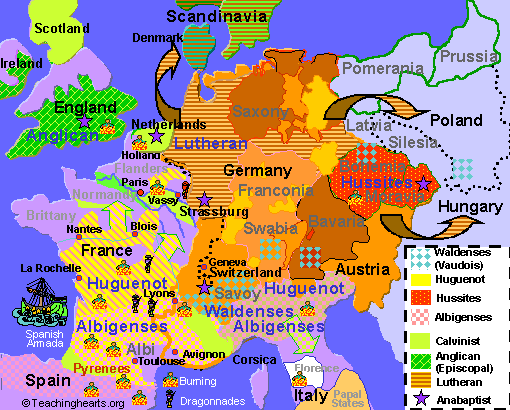
| Map of Protestant Distribution |
After the death of Wenceslaus IV of Bohemia in 1419, the Hussites took up arms to prevent
Emperor Sigismund from succeeding to the throne. They were without a king between 1429 and 1436. While this War of Succession was going on, the crusades against the Hussites began.
The crusades against the Czech Hussites were mostly a failure until the Council of Basil in 1433.
At this time, moderate Hussites recanted their heresy and went back to the Catholic Church.
This caused disagreement and the civil war broke out between the Utraquists and the Taborites (lower class).
In Bohemia, a country with a population of four million by the year 1600, 3.2 million of which were Protestants, only the population of 800,000 Catholics were left alive by the time the Hapsburgs and Jesuits were through.
2,400,000 Protestants were cruelly murdered.
Papal Persecutions - Waldensians (1147-1658)
|
Meet the Popes of this Era |
|---|---|
| All sinners | |
| Boniface VIII | Adultery and homosexual activity |
| Clement V | Loved prostitutes |
| Paul II | Homosexual, who liked bondage and lust. Died of a heart attack while being sodomized |
| Alexander VI | Incest, adultery, illegitimate children, Orgies in the papal palace |
By the year 1140, there was a large number in the reformed movement, and their popularity alarmed the pope, prompting him to gather scholars to write against their doctrines and to ask several princes to banish them from their dominions.
By 1147 Peter Waldo of Lyons became a popular preacher among the reformed and they came to be known as Waldensians. Pope Alexander III excommunicated Waldo and his followers and asked the Bishop of Lyons to exterminate them from the face of the earth. So the persecution of the Waldensians began. This was the first time that the system of the Inquisition was used. Any open or anonymous accusation was sufficient evidence of guilt. The Dominician Order was formed from a monk named Dominic who was tasked with debating the Waldensians out of their beliefs. The Dominicans had been principally responsible for being the inquisitors in all future inquisitions.
Property Stolen.
No one of any race, gender, wealth or rank was spared from the inquisition. To be rich was automatically a proof of being a heretic.
People's property was confiscated. Their heirs were robbed of their inheritance.
Some were sent to the Holy land and the Dominicans took possession of their property and pretended not to know them when they returned.
Others could not visit their loved ones in jail, give them fresh straw to sleep on or give them a cup of water,
nor could any lawyer plead for their cause because they would be prosecuted for favoring a heretic.
Their malice went so deep that even after death, anyone accused of heresy had their bones dug up and publicly burned.
So the church not only used this inquisition to accuse people of heresy, they also used it as an opportunity to rob the rich of their property.
Papal Persecutions - Albigensians
The Albigenses or Carthari were French Protestants in southern France, northern Italy and northern Spain, a people of the reformed religion, who inhabited the country of Albi. The Albigensian heretics were also known as Cathari or Cathars.
Pope Alexander III condemned the religion in the Council of Lateran, but their numbers still increased.
The Albigenses were members of the reformed church who believed in dualism, they believe God created Christ and the Holy Spirit.
They did not believe in purgatory, resurrection, the priesthood, veneration of images, sacraments or the Nicene Trinity.
In 1208, Pope Innocent II asked King Philip II to eradicate the heresy and called the crusade to combat the heresies.
In the crusading Bull, the pope promised paradise and the land of the defeated was promised to the victors.
So a land rush began.
An inquisition was also called against the people - those who did not recant were burned, those who did were forced to wear yellow crosses.
This struggle against the Christians of Southern France lasted 20 years.
In one battle alone, an estimated 60,000 were slaughtered by Pope Innocent II
in the siege of the city of Beziers, France in 1209.
King Luis VIII again lead the crusade to exterminate the Albigenses in 1226.
Many were beaten, racked, scourged, and burnt to death.
At the height of the crusade a hundred were burned at the stake at a time.
Papal Persecutions - Huguenots (1562 -1598)
"Une foi, un loi, un roi," (one faith, one law, one king) was the motto of the French. The French wars of religion was
caused by growth of Calvinism, noble factionalism, and weak royal government. From 1550's Calvinist or Huguenot numbers
increased, fostered by missionary activities in Geneva. Noble factions of Bourbons, Guise, and Montmorency were split by
religion as well as by family interests. Civil wars were encouraged by Philip II's support of Catholic Guise faction and
by Elizabeth I's aid to Huguenots (French Protestants).
The wars of religion started with the Massacre at Vassy in 1592 when servants of the Duc de Guise fired on the unarmed Huguenot and set the church on fire.
The most notable incidents of these wars were the Saint Bartholomew's Day Massacre and
the slaughter of the Protestants under Louis XIV.
Pope Pius V decreed the extermination of Huguenots and asked all loyal Catholics to help hunt them down.
Saint Bartholomew's Day Massacre of Huguenots in France (August 24, 1572)
Catherine de Medici, the mother of the King of France arranged a fake wedding between her daughter, Margot de Valois, and Henri de Navarre
who was a Protestant leader. The marriage was publicly conducted on August 17 and was attended by the Cardinal of Bourbon.
Four days later with a prearranged signal at midnight the homes of Protestants were entered.
Admiral de Coligny, the chief military leader of the Huguenots, was stabbed by an assassin, in the chest with a sword in his own bedroom.
Then they threw him out of a window into the street, cut off his head and sent it to the pope.
Then they cut off his arms and private members, dragged him through the streets for three days, and hung him by the heels outside the city.
For many days they killed as many Protestants as they could, starting with the upper class. In the first 3 days 10,000 were killed and their bodies thrown into the river.
The bloodbath spread from Paris to other parts of the country and in a week over 100,000 Protestants were killed across the kingdom.
Some priests, holding up a crucifix in one hand, and a dagger in the other, ran to the chiefs of the murderers, and strongly exhorted them to spare neither relatives nor friends
Many who gave great sums of money for their ransom were immediately slain; and several towns, which were under the king's promise of protection and safety, were cut off as soon as they delivered themselves up, on those promises, to his generals or captains.
Rome Celebrates the Massacre
 | |
| Front | GREGORIVS • XIII • PONT • MAX • AN • 1. Gregory XIII Great Pontiff Year 1 |
|---|---|
| Back | UGONOTTORUM STRAGES 1572 Huguenots Slaughtered 1572 |
In France, the king also commanded the day to be kept with every demonstration of joy, believing that the whole race of Huguenots was now extinct.
The Edict of Nantes (1598)
The Edict of Nantes was made by Henry the Great of France in 1598.
It gave the same civil and religious liberty rights to the Protestants that it gave other citizens.
Pope Clement VIII called it a "cursed thing". It was in opposition to the Council of Trent which issued over 100 anathemas against the Protestants.
Henry IV was a Protestant who converted to Catholicism because the Catholics would not tolerate a Protestant king.
He was assassinated by being stabbed in the chest.
Dragonnades (1681)
In 1681, after Louis XIV failed to eliminate the Huguenots, he forced them to allow soldiers to stay in their homes.
The soldiers orders were to force them to give up their faith.
Day and night these soldiers tortured, beat and terrorized the Protestants.
Tens of thousands "converted" in weeks.
Slaughter of French Huguenots under King Louis XIV (1685)
|
|---|
It cost me many threats and promises, before I could bring it thus far, our King being a long time very unwilling. But at last I got him on the hip, for he had lain with his daughter-in-law, for which I would by no means give him absolution, till he had given me an instrument under his own hand and seal, to sacrifice all the heretics in one day. Now, as soon as I had my desired commission, I appointed the day when this should be done; and in the meantime made ready some thousands of letters to be sent into all parts of France in one post night.
On page 149 of "The Two Babylons" by Hislop it also quotes the priest:
Many a time since, when I have had him at confession, I have shook hell about his ears, and made him sigh, fear and tremble, before I would give him absolution. Nay, more than that, I have made him beg for it on his knees before I would consent to absolve him. By this I saw that he had still an inclination to me, and was willing to be under my government; so I set the baseness of the action before him by telling the whole story, and how wicked it was, and that it could not be forgiven till he had done some good action to balance that, and expiate the crime. Whereupon he at last asked me what he must do. I told him that he must root out all heretics from his kingdom. This was the "good action" to be cast into the scale of St. Michael the Archangel, to "balance" his crime. The king, wicked as he was - sore against his will - consented; the "good action" was cast in, the "heretics" were extirpated; and the king was absolved.
This slaughter began with the revocation of the Edict of Nantes October 18, 1685 by Louis XIV although it was the Protestants who helped him to ascend the throne
following years of bloody civil wars. He even confirmed the Edict of Nantes with his own edict of Nismes.
|
|---|
The Persecution of the Vaudois (1686).
Next, Louis XIV forced the Duke of Savoy, Victor Amadeus, to murder the Waldenses (Vaudois) in the Piedmont Valleys.
He sent an ambassador to tell the duke that he should deal with the Vaudois in the same way that
he was dealing with the Huguenot.
The Duke was unwilling to do this because they were such loyal subjects who had recently helped him in battle.
He had just sent them a letter of gratitude.
Louis made this request three times before he threatened to send an army of 14,000 men to do the job.
So, on January 31, 1686 the edict was pronounced. It had the same terms as the Edict of Nantes and it removed all their rights.
And it lead to their slaughter.
The Inquisitions
The word inquisition means "to inquire into".
By the middle ages when the church heretics came to be regarded as enemies of the state
and persecution of the heretics was still mostly unorganized.
The inquisition was an attempt to organize and bring order and legality to the process.
By this time the state and the church were unified and people felt that heresy threatened the order of society.
So heresy was both a crime against church and civil law.
The church sought out those accused of the crime and first tried to instruct them in the Catholic doctrine.
If the person insisted in their belief, then they were handed over to the state for punishment - usually burning at the stake.
By the end of all three official inquisitions over 68,000,000 Protestants, Pagans and heretics were murdered.
|
Meet the Pope |
|---|---|
| Sixtus IV | |
| Incest, bisexual activity, a benefactor to prostitutes. Gave his family wealth and position in the church. | |
The Inquisition started with the goal of eliminating heresy and enforcing church law.
Inquisitorial methods included:
Use of tortured informants,
torture driven confessions,
confiscation of property,
lengthy secret imprisonment,
secret trials, and
death by burning.
The Spanish Inquisition Persecution Tests.
Tests were devised to detect secret Jews. An acceptable evidence of guilt included the following:
The Reformation: Martin Luther
In 1517, Johann Tetzel appeared in Germany selling a special indulgence issued by the Pope.
This was the straw that broke the camel's back.
The Protestant religious revolution was initiated in Germany by Luther in 1517, when he published his 95 theses challenging the theory and practice of selling indulgences.
He advocated that religion rests on individual faith based on the guidance contained in the Bible.
The reformation ended the supremacy of the Pope and gave birth to the Protestant churches.
The reformation eventually led to the Renaissance (or the rebirth of learning) and culminated in the French Revolution.
The French revolution ended the political power of the pope and started the era of secular, modern history.
Pressure was brought on Luther by both the church and state.
Ordered to recant and to submit to church authority, he defied the church by publicly burning a copy of the canon law and the papal bull which ordered his excommunication.
In 1521, Charles V, Holy Roman emperor, and the German princes assembled at the Diet of Worms and ordered Luther to recant.
He refused and was declared an outlaw.
For almost a year he remained in hiding, writing pamphlets expounding his principles and translating the New Testament into German.
Although his writings were prohibited by imperial edict, they were openly sold and were powerful instruments in turning the great German cities into centers of Lutheranism.
The spirit of reformation started in many countries and were headed by many who were later martyred.
| National Movements and Leaders | ||||
|---|---|---|---|---|
| Year | Reformer | Country | Church | Comments |
| 1324-1384 | John Wycliffe | England | Lollards | Preached against the doctrine of transubstantiation and the auricular confession, and translated the Bible into English. Forty one years after his natural death, his body was dug up and burned as a heretic and the ashes were thrown into the Swift river. |
| 1415-1416 | Huss | Europe | Waldenses | They criticized the Roman view of the sacraments, rejected prayers to the saints, indulgences, purgatory, worldly pomp for the church, prayers for the dead. He was burned at the stake in 1415 and their ashes thrown into the Rhine river. |
| 1517 | Luther | Germany | Lutheran | 95 Theses |
| 1518 | Zwingli | Switzerland | Reformed | Denounced the sale of indulgences. Religious relics were burned, removed icons, ceremonial processions and adoration of saints were abolished, priests and monks were released from their vows of celibacy, and the Mass was replaced by a simpler communion service. Executed in 1529 and his body burned and scattered. |
| 1525 | Zwingli | Switzerland | Anabaptists Mennonites | Characterized generally by believers' baptism, refusal of infant baptism, an emphasis on piety and good works, an aversion to the state-run churches |
| 1536 | Calvin | Geneva | Reformed | :. |
| 1559 | Calvin | France | Huguenots | A belief in justification by individual faith alone; he also denied the doctrine of transubstantiation. |
| 1560 | John Knox | Scotland | Reformed, Presbyterian | Calvinism |
| 1534 | King Henry VIII | England | Anglican | The king wanted the church to annul his marriage to Catherine of Aragón because no male heirs were produced. But the church would not. |
Anabaptist sects include Mennonites, Amish, Brethren and Hutterites.
Puritanism and congregationalism: Baptists
The Counter-Reformation
The church reacted to the reformation and Protestantism by forming many organizations and organized persecutions.
The Inquisition officially started in 1231. The vast majority of the murders of 50-100 million Christians occurred during the Inquisitions and especially during the period after the Reformation movement of 1517.
Several religious orders were formed to crush the Reformation by force, lies and by scholarly rebuttal.
With their scholarly knowledge and with their legal powers as inquisitors, they went on to exterminate hundreds of millions of Christians.
The Jesuit Extreme Oath of Induction
This is supposed to be the Jesuit Extreme Oath of Induction as recorded in the Congressional Record of the U.S.A. (House Bill 1523, February 15, 1913, pages 3215-3216):
I ______, now in the presence of Almighty God, the Blessed Virgin Mary, the Blessed Michael the Archangel, the Blessed St. John the Baptist, the Holy Apostles, Peter and Paul, and all the Saints, sacred hosts of Heaven, and to you, my ghostly Father, the Superior General of the Society of Jesus, founded by St. Ignatius Loyola, in the Pontification of Paul the Third, and continued to the present, do by the womb of the virgin, the matrix of God, and the rod of Jesus Christ, declare and swear that his holiness, the Pope, is Christ's Vice-regent, and is the true and only head of the Catholic or Universal Church throughout the earth; and that by the virtue of the keys of binding and loosing, given to his Holiness by my Savior, Jesus Christ, he has power to depose heretical kings, princes, states, commonwealths and governments, all being illegal without his sacred confirmation, and that they may be safely destroyed.
I do further promise and declare, that I will have no opinion or will of my own, or any mental reservation whatever, even as a corpse or cadaver but unhesitatingly obey each and every command that I may receive from my superiors in the Militia of the Pope and Jesus Christ.
...I do further promise and declare, that I will, when opportunity presents, make and wage relentless war, secretly or openly, against all heretics, Protestants and Liberals, as I am directed to do to extirpate and exterminate them from the face of the whole earth, and that I will spare neither sex, age nor condition, and that I will hang, waste, boil, flay, strangle and bury alive these infamous heretics; rip up the stomachs and wombs of their women and crush their infants heads against the wall, in order to annihilate forever their execrable race.
That when the same cannot be done openly, I will secretly use the poison cup, the strangulation cord, the steel of the poniard, or the leaden bullet, regardless of the honor, rank, dignity or authority of the person or persons whatsoever may be their condition in life, either public or private, as I at any time may be directed so to do by any agent of the Pope or superior of the Brotherhood of the Holy Faith of the Society of Jesus.
Summary of the Methods and Tactics of Persecution
Since the church technically has no army, it uses the faithful and the armies of the nations it controls.
Soldiers are recruited by many tactics.
Recruiting an Army
Methods of Persecution
The persecuted are tormented by various methods:
Methods Of Torture
Even the Muslims have come to refer to this as Christian barbarism.
One cruel fact about these evil acts were the fact they found ways to prolong the torture so
that the victim would be conscious for as long as possible. Here are some of the methods:
| |||||||||||
|---|---|---|---|---|---|---|---|---|---|---|---|
|
|---|
I know that persecutions will occur again. So while we all believe that this could never happen again, I urge you to think. Would Christ have done any of the atrocities listed above?
Meet Some Martyrs For Christ
|
|---|
 Almericus, Martyr for Christ:
In the third century a learned man, named Almericus, and six of his disciples, were ordered to be burnt at the stake in Paris for asserting that God was no more present in the sacramental bread than in any other bread; that it was idolatry to build altars or shrines to saints and that it was ridiculous to offer incense to them.
Jean Vallière, Martyr for Christ John Clark, Martyr for Christ A Baby (One minute old), Martyr for Christ:
A baby was stabbed to death right after it was born. The mother was a Protestant killed in childbirth during the St. Bartholomew's Day Massacre.
This baby was born alive and immediately stabbed to death.
Romanus, Martyr for Christ:
Romanus, a native of Palestine, was a deacon of the church of Caesarea at the time of the commencement of Diocletian's persecution.
He was condemned for his faith at Antioch. As punishment, he was scourged, put to the rack, his body torn with hooks, flesh cut with knives, face scarred, teeth beaten from their sockets, and his hair plucked up by the roots.
Soon after, he was ordered to be strangled, November 17, A.D. 303.
300 Christians at Utica, Martyrs for Christ:
At Utica, three hundred Christians were placed around a burning kiln.
They were commanded either to sacrifice to Jupiter, or to be thrown into the kiln. Unanimously refusing, they bravely jumped into the pit, and were immediately suffocated.
4 Palestinian Christians, Martyrs for Christ:
Alexander, Malchus, and Priscus, three Christians of Palestine, and a woman of the same place, voluntarily admitted to being Christians.
They were sentenced to be devoured by tigers.
7 Roman Soldiers, Martyrs for Christ:
In 251, the emperor Decius erected a pagan temple at Ephesus and commanded all who were in that city to sacrifice to the idols.
This order was nobly refused by seven of his own soldiers, Maximanus, Martianus, Joannes, Malchus, Dionysius, Seraion, and Constantinus.
The emperor gave them time to change their decision and during his absence they escaped, and hid themselves in a cavern.
On his return he ordered the mouth of the cave to be closed up, and they all died of hunger.
Other Martyrs for Christ:
Almericus, Martyr for Christ:
In the third century a learned man, named Almericus, and six of his disciples, were ordered to be burnt at the stake in Paris for asserting that God was no more present in the sacramental bread than in any other bread; that it was idolatry to build altars or shrines to saints and that it was ridiculous to offer incense to them.
Jean Vallière, Martyr for Christ John Clark, Martyr for Christ A Baby (One minute old), Martyr for Christ:
A baby was stabbed to death right after it was born. The mother was a Protestant killed in childbirth during the St. Bartholomew's Day Massacre.
This baby was born alive and immediately stabbed to death.
Romanus, Martyr for Christ:
Romanus, a native of Palestine, was a deacon of the church of Caesarea at the time of the commencement of Diocletian's persecution.
He was condemned for his faith at Antioch. As punishment, he was scourged, put to the rack, his body torn with hooks, flesh cut with knives, face scarred, teeth beaten from their sockets, and his hair plucked up by the roots.
Soon after, he was ordered to be strangled, November 17, A.D. 303.
300 Christians at Utica, Martyrs for Christ:
At Utica, three hundred Christians were placed around a burning kiln.
They were commanded either to sacrifice to Jupiter, or to be thrown into the kiln. Unanimously refusing, they bravely jumped into the pit, and were immediately suffocated.
4 Palestinian Christians, Martyrs for Christ:
Alexander, Malchus, and Priscus, three Christians of Palestine, and a woman of the same place, voluntarily admitted to being Christians.
They were sentenced to be devoured by tigers.
7 Roman Soldiers, Martyrs for Christ:
In 251, the emperor Decius erected a pagan temple at Ephesus and commanded all who were in that city to sacrifice to the idols.
This order was nobly refused by seven of his own soldiers, Maximanus, Martianus, Joannes, Malchus, Dionysius, Seraion, and Constantinus.
The emperor gave them time to change their decision and during his absence they escaped, and hid themselves in a cavern.
On his return he ordered the mouth of the cave to be closed up, and they all died of hunger.
Other Martyrs for Christ:
Estimates of the Number of Martyrs
The estimates seem to range from fifty million to over one hundred million killed and this does not seem to include the
Catholics killed, or the Protestant persecutions of other minorities. Therefore, the total killed during the organized campaign to enforce religion on the
population could be over 200,000,000.
In addition, the total number who were banished, tortured or imprisoned could be a magnitude of ten times the number killed.
So the total cost in misery cannot be estimated.
In the case of the slaughter of the Huguenots under King Louis XIV, the ministers were trapped so that they were forced
into a life of torture as galley slaves. Therefore, death might have been better.
So the number tortured is just as important as the number killed.
| Persecuted | Campaign | Year | Total Deaths | High Estimate Source | |
|---|---|---|---|---|---|
| Total Estimates | Low | High | |||
| Crusades (Holy land) | 1095-1272 | 7,000,000 | 20,000,000 | Wollschläger | |
| Crusades (Spain) and the conquest of Spain | 1095-1272 | 5,000,000 | 5,000,000 | Middleton | |
| Crusades (Albigenses) | 1208 | 900,000 | 1,000,000 | Wollschläger | |
| Saracen slaughter | - | 7,000,000 | 7,000,000 | Middleton | |
| Inquisition | 1518- | a50,000,000 | a68,000,000 | Brownlee | |
| Witches | 1400-1800 | 9,000,000 | 20,000,000 | Voltaire | |
| Saxons and Scandinavians | - | 2,000,000 | 2,000,000 | M. D. Aletheia | |
| Thirty years war | 1618-1648 | 7,500,000 | 11,500,000 | Rummel c | |
| Conquistadores and colonial period | - | b15,000,000 | 49,500,000 | Rummel c | |
| New world after the colonial period | - | 8,763,000 | 8,763,000 | Rummel c | |
| Other religious wars | - | - | - | - | |
| Other forced conversions | - | - | - | - | |
| Total | 112,163,000 | 192,763,000 | - | ||
| Individual Estimates | |||||
| Heretics | All Crusades | 1095- | d26,000,000 | d Calculated | |
| Muslims | Crusades | 1095-1272 | 7,000,000 | Middleton | |
| Jews | Crusades | 1095 | 12,000 | - | |
| Albigensians | Crusades (Total) | 1208-1249 | 1,000,000 | Ellerbe | |
| Albigensians | Crusades (Beziers) | 1208- | 60,000 | - | |
| Saracens | Saracen slaughters in Spain | - | 7,000,000 | Aletheia | |
| Heretics | All Inquisitions | 1231-1834 | 68,000,000 | - | |
| Protestants | Inquisition | 1231-1834 | 50,000,000 | Brownlee | |
| Jews | Spanish Inquisition | 1478-1834 | 32,000 | A History of the Jews | |
| Waldenses | Inquisition | 1540-1570 | 900,000 | Halley's Bible Handbook | |
| Huguenots | Huguenot wars | 1562-1598 | 200,000 | - | |
| Huguenots | St. Bartholomew's Day Massacre | 1572 | 100,000 | Fox's Book of Martyrs | |
| Jews | Blamed for the Black Death | 1348 | 14,000 | Davies | |
| Netherlands | Dutch revolt | 1566-1609 | 100,000 | Gibbon | |
| Hussites | Wars: Bohemia and Moravia | 1600- | 2,400,000 | - | |
| Thirty years war | Make Germany Catholic | 1618-1648 | 7,500,000 | Dunn, Wedgwood | |
| Huguenots | Edict of Nantes revoked | 1685 | 500,000 | - | |
| Irish | Irish massacres | 1651 | 200,000 | Sorokin | |
| Irish | Irish uprising | 1790 | 50,000 | Dan Smith | |
| Colonna family | Massacre at Palestrina | 130? | 6,000 | - | |
| Lollards | Burning followers of Wycliffe | 1401- | - | - | |
| French Vaudois | Ordered by Innocent VIII | 1487- | - | - | |
| Fires of Smithfield | Bloody Mary of England | 1553-1558 | 283 | Burnet | |
| Moors | All | - | 3,000,000 | Brownlee | |
| Jews | All | - | 1,500,000 | Brownlee | |
| Modern Events | |||||
| Jews | Nazi Germany | 1943 | 6,000,000 | - | |
| Serbs | Croatian dictator Ante Pavelic | 1943 | e544,000 | - | |
| Protestants | Colombia | 1949-1953 | 60,000 | Raywood Frazier | |
| Christians | Soviet Union Communists | 1921-1980 | 20,000,000 | Barrett | |
| Christians, animist | Arab Muslims in the Sudan | 1983-2001 | 2,000,000 | Newsroom | |
| Black Muslims | Arab Muslims in the Sudan | 1983-2004 | 1,000,000 | - | |
| Rwanda Tutsi | Hutu majority. 100 days | 1994 | 800,000 | Frontline | |
| Muslims | Serbs, Srebrenica maccacre | 1995 | 7,000 | News reports | |
| Muslims | Sudan | Occurring | 400,000 | News reports | |
|
|||||
| I also calculated the expected population using very conservative growth rates and I found that by the time of the middle ages, the population was hundreds of millions less than it should be. Instead of an estimated population of 2.6 billion there was only 745 million. After accounting for deaths by plague and war there were still about two hundred million missing people. | |||||
| Year | Population | Growth | Events | ||
|---|---|---|---|---|---|
| World | Europe | World | Europe | ||
| 1000-1100 | 320 | 44 | 20.8% | 22.0% | - |
| 1100-1200 | 360 | 58 | 12.5% | 31.0% | Crusades |
| 1200-1300 | 360 | 79 | 0% | 36.0% | Inquisition |
| 1300-1400 | 350 | 60 | -2.8% | -24.0% | Plagues |
| 1400-1500 | 425 | 81 | 21.4% | 35.0% | - |
| 1500-1600 | 545 | 100 | 28.2% | 23.0% | Reformation |
| 1600-1700 | 610 | 120 | 12.0% | 20.0% | Reformation |
| 1700-1800 | 915 | 180 | 50.0% | 50.0% | Revolution |
Catholic Sources. Catholic historian Vergerius admits that during the Pontificate of Pope Paul IV (1555-1559)
" the Inquisition alone, by tortures, starvation, or the fire, murdered more than 150,000 Protestants."
 The Catholic church does not agree with these numbers.
In some writings that I have found, the charge is made that these death totals are based on Protestant revisionist history.
They claim that there was not enough people to kill and the plagues were to blame for most deaths.
They estimate that the total deaths due to the inquisition were closer to 3,000 or 4,000. - The Myth of the Spanish Inquisition - 1994 BBC / A&E; production
The Catholic church does not agree with these numbers.
In some writings that I have found, the charge is made that these death totals are based on Protestant revisionist history.
They claim that there was not enough people to kill and the plagues were to blame for most deaths.
They estimate that the total deaths due to the inquisition were closer to 3,000 or 4,000. - The Myth of the Spanish Inquisition - 1994 BBC / A&E; production
Significant Developments in These Times
Modern Persecutions by the Church
The church is marketing Protestant evangelism as evil for families and disruptive of the common good.
Whenever the church has the opportunity it tries to stamp out all traces of Protestants.
When it is in the majority it openly and unashamedly persecutes viciously. Let other nations be warned.
After the collapse of the Soviet Union, religion entered these countries again.
The church quickly moved to regain the property it lost as a result of the takeover of communism
but it encouraged the new lawmakers to deny Protestant churches this same right by keeping their property.
In addition, Protestant churches were forced to register. After a while, the rules were tightened to allow only people who had a presence for over twenty years.
This excluded any new religions and old groups who had not been in the Soviet Union before communism.
Mexico
Mexico is over 90% Catholic and the Roman Catholic intends to make it 100%. While in the majority it makes no pretence about ecumenism and 'separated brethren'.
They are generally hostile toward evangelicals and encourage violence to discourage Protestant evangelism.
In the 1980s a Seventh-Day Adventist minister had his arms chopped off by a Catholic mob urged on by the priest.
The church looks on evangelicals as trouble makers who are destroying families.
A large Pentecostal denomination was notified in March of 1991 that all churches not registered with the government would be closed within three months.
In one Pentecostal group, over 30 churches were closed due to threats of violence by radically-minded Catholics.
Two evangelicals were also stoned to death by Catholics.
Nicaragua
The Roman Catholic hierarchy is pressuring Nicaragua's public schools to use text books which promote Catholicism and which blame racial tension and other societal problems on Protestants.
The textbooks are produced by the Catholic archdiocese of Managua.
A textbook for fourth grade of secondary schools has the picture of Pope John Paul II on the cover and warns Protestants not to criticize Catholic devotion to the Virgin Mary:
According to the textbook, 'To scorn Mary is an absurdity, something only the devil can incite'.
Be careful, Protestant brothers. You're playing with fire. If you want to increase your numbers by misleading unprepared Catholics, don't mess with Mary, the Mother of Jesus and our mother. It's something serious for which you'll pay heavily. (Ecumenical News International, April 28, 1997).
Colombia
Between 1949 and 1953, there was intense persecution of those who were not Catholics in Colombia.
There is evidence of at least 60,000 deaths.
Pope Pius XII awarded the President of Columbia with one of the highest awards from the Church, and praised Columbia for its example of the Catholic faith.
The response to this is that other churches are not founded by God and should be wiped out with fire.
The defense of Roman Catholics to this presentation is as follows:
"Communists destroy churches because they are God's enemies; Catholic's destroy churches because they are God's friends ... Against such men - founded churches ... Catholics in Latin America should arise and wipe them out with fire." John J. Oberlander, in The Voice of Freedom, 1954, page 20.
Summary of the Popes and their Activities
The Catholic Church claims a line of succession from the Apostle Peter (designated the first pope) down to the current
pope. I will just list the popes that had significant historical events during their rule.
| Number | Pope | Year | Significant Event |
|---|---|---|---|
| 45 | Leo I, the Great | 440-461 | Suppressed Manichaeanism, a Christian sect |
| 59 | Vigilius | 537-555 | The Church gained full political control |
| 64 | Gregory I, the Great | 590-604 | Ban on literacy, sold relics |
| 97 | Saint Leo III | 795-816 | Council of Aix-la-Chapelle (836) claimed that after his rule, convents became brothels and monasteries became filled with homosexuals |
| 114 | Stephen VII | 896-897 | Exhumed the corpse of the previous pope and tried it for perjury and for coveting the papacy. |
| 131 | John XII | 955-963 | Rape, vandalism and theft. Convicted of incest, adultery and murder in 962 by Otto I. Made the Lateran a brothel |
| 146 | Benedict IX | 1032-1048 | "A disgrace to the Chair of St Peter", according to the Catholic Encyclopedia. Murder, bestiality, bisexual, homosexual orgies, witchcraft and Satanism. |
| 153 | Saint Leo IX | 1049-1054 | The separation of the Greek church |
| 158 | Saint Gregory VII | 1073-1085 | Celibacy in the clergy. Right to depose emperors. |
| 160 | § Blessed Urban II | 1088-1099 | The First Crusade. Canonised in 1881. 12,000 Jews murdered in the Rhineland |
| 161 | Paschal II | 1099-1118 | Continues the crusades of Urban II |
| 168 | § Blessed Eugene III | 1145-1153 | The Second Crusade |
| 171 | Alexander III | 1159-1181 | Waldensian persecution |
| 174 | Gregory VIII | 1187 | The Third Crusade - issues bull |
| 175 | Clement III | 1187-1191 | The Third Crusade |
| 177 | Innocent III | 1198-1216 | The Fourth Crusade.
1212 - The Children's Crusade |
| 178 | Honorius III | 1216-1227 | The Fifth Crusade |
| 179 | Gregory IX | 1227-1241 | The Sixth Crusade. 1231 - Papal Inquisition |
| 181 | Innocent IV | 1243-1254 | The Seventh Crusade with Louis IX of France. First to officially sanction torture in the Inquisition. |
| 184 | Clement IV | 1265-1268 | The Eighth Crusade |
| 185 | § Blessed Gregory IX | 1271-1276 | The Ninth Crusade |
| 193 | Celestine V | 1294 | He was known as a good man |
| 194 | Boniface VIII | 1294-1303 | Palestrina Massacre . Evil, immoral, thief, murderer, rape, simony, fornicator, adulterer. Organised pilgrimages to St Peter, for the full pardoning of sins - after paying a tribute. |
| 196 | Clement V | 1305-1314 | Rebukes England's King Edward II for not torturing heretics and orders him to do so |
| 199 | Clement VI | 1342-1352 | 350 separate massacres of Jews by Christians during three years of the Black Death after 1348 |
| 207 | Martin V | 1417-1431 | Orders extermination of the Hussites (1429) |
| 213 | Sextus IV | 1471-1484 | The Spanish Inquisition |
| 214 | Innocent VIII | 1484-1492 | Waldensians, French Vaudois (1487) and witches persecutions |
| 215 | Alexander VI | 1492-1503 | Hosted orgies, incest, adultery, prostitution |
| 217 | Julius II | 1503-1513 | Created the system of indulgences |
| 218 | Leo X | 1513-1521 | The Reformation The Diet of Worms, ordered the sale of indulgences |
| 221 | Paul III | 1534-1549 | Established the Holy Office (Roman Inquisition) |
| 224 | Paul IV | 1555-1559 | The Roman Inquisition especially in Italy, Netherlands and the orient. Forced Jews to wear yellow hats. In 1557, he created the "Index of Forbidden Books" |
| 226 | Pius V | 1566-1572 | Orders the extermination of Huguenots and asks all loyal Catholics to help hunt them down |
| 227 | Gregory XIII | 1572-1585 | 1572 Saint Bartholomew's Day Massacre |
| 236 | Urban VIII | 1623-1644 | The Thirty Years War. Forced Galileo to recant his scientific theories. |
| 241 | § Blessed Innocent XI | 1676-1689 | The revocation of the Edict of Nantes. Huguenot and Waldenses persecuted. |
| 251 | Pius VI | 1775-1799 | Taken prisoner by General Berthier of France |
| 256 | Pius IX | 1846-1878 | Papal infallibility, the dogma of the Immaculate Conception |
| 261 | Pius XII | 1939-1958 | Hitler's Pope. Remained silent about the murder of Jews and Serbs |
| 265 | John Paul II, the Great | 1978-2005 | Brought the church back from its prophetic wounds. (Karol Wojtyla of Poland) |
| 266 | Benedict XVI | 2005- | Will he be the last Pope? (Joseph Ratzinger of Germany) |
| § The title "Blessed" means that they are on the path to becoming a saint | |||
Papal Bulls and Encyclicals. Here are a few of the most famous laws issued by the popes.
| Infamous Bulls or Laws Passed | |||
|---|---|---|---|
| Law | Year | Pope | Contents |
| Christmas | 340 | Julius I | Made December 25 the official Christmas day - the birth of the Persian savior Mithra |
| Heresy | 3?? | Damasus I | Defined heresy as not obeying the doctrines of the church |
| Cullagium | 10?? | Urban II | Allowed a priest to keep a mistress as long as he paid an annual fee |
| Deliberato | 1??? | Innocent III | Claimed the right to depose kings, condemned the magna charta, forbids Bible reading in the common language. He ordered the extermination of heretics and the massacre of Albigensians |
| Ad extirpanda | 1252 | Innocent IV | Ad extirpanda means "to be exterminated" ordered all secular rulers to arrest and execute non-Catholic Christians. Ordered the civil magistrates to force a confession of guilt from all heretics by torture |
| Unam Sanctum | 1302 | Boniface VIII | Salvation required submission to the pope. He was one of the most immoral popes.
"We, moreover, proclaim, declare and pronounce that it is altogether necessary to salvation for every human being to be subject to the Roman Pontiff." |
| Vox in excelsis | 1312 | Clement V | Found no reason for the condemnation of the order of the Knights Templars. He declared them innocent. They were still persecuted. |
| Cum inter nonnullos | 132? | John XXII | It was heresy to suggest Jesus and his apostles owned no property |
| Spanish Inquisition | 1479 | Sixtus IV | Allowed the Spanish Inquisition |
| Summis desiderantes affectibus | 1484 | Innocent VIII | Allowed the persecution of witches |
| Cum nimis absurdum | 155? | Paul IV | Created the first Jewish ghetto in Rome. He suspected them of helping Protestants and forced them to sell their property and wear yellow hats. He restricted their commercial activity to selling second hand clothes, thus guaranteeing their poverty. |
| Sacratissimo uti culmine | ???? | John XXII | If you are wearing the Carmelite scapular at death, Mary will personally escort you to heaven the first Saturday after you die.
"I, the Mother of grace, shall descend on the Saturday after their death and whomsoever I shall find in Purgatory, I shall free, so that I may lead them to the holy mountain of life everlasting." |
| | 1998 | John Paul II | Encyclical written May 31. "Christians will naturally strive to ensure that civil legislation respects their duty to keep Sunday holy." |
The Office of the Papacy
Here is an example of how the popes view themselves:
Innocent III, who ordered the murder or millions, described himself as
"set between God and man, lower than God but higher than man, who judges all and is judged by no one. . ."
He declared that, "the priesthood was as superior to the kingship as the soul to the body," and he informed the nobles of Tuscany that, "just as the moon derives its light from the sun ... so too the royal power derives the splendor of its dignity from the pontifical authority."
The pope is of so great dignity and so exalted that he is not a mere man, but as it were god, and the vicar of God ...
The pope is crowned with a triple crown, as king of heaven and earth and the lower regions ...
The pope is of so great authority and power that he can modify, explain or interpret even divine laws ...
The pope can modify divine law, since his power is not of man but of God, and he acts as vicegerent of God upon earth with most ample power of binding and loosing sheep
The pope is as it were god on earth, sole sovereign of the faithful of Christ, chief of kings, having plenitude of power, to whom has been entrusted by the omnipotent God direction not only of earthly but also of the heavenly kingdom ...
Just in case you think that the church has changed and that was a relic from the past - here is the current world view as seen by the present pope. It is described in a 700 page book called The Keys of this Blood by Malachi Martin (1990) All groups are categorized and accessed by their globalist ideals and their threat to the pope as the new geopolitical world leader.
| Globalist Group | Sub Group | Religious group | Comments |
|---|---|---|---|
| Provincial Globalists | Those who want to hold on to their unique beliefs and way of life. Most believe in the rights of others to choose their own destiny. | ||
| Angelists | Islam | Believes that with their acceptance of Christ and Mary they will one day turn to Christianity | |
| Minimalists | Baptists, Evangelicals, Seventh-Day Adventist, Jehovah's Witnesses, Mormons and Christian Scientists | Expect to be a minimum of the world's population until the last day. Also expects them to be in opposition with him. | |
| Eastern Christians | Eastern Orthodox, Greek Orthodox and Christian minorities in the Middle East | Caught in historical crevasses from which there is no retreat, no advance, no escape (page 287) | |
| Non-Christian | Animism, Shintoism, Hindusim, Buddhism | Holds a fascination for primitive things | |
| Separatists | Japanese, Chinese, Jews | Very separatist with no formal organization or desire to convert the world to their beliefs | |
| Piggy - Back Globalists | Those who will accept any beliefs or systems that appear to be popular | ||
| Mega-Religionists | Baha'i, Unitarian Universalist, Temple of Understanding (TU), Organization of United Religions (OUR) and many others | Believe that all religions must quickly fuse into one great ethical world religion - the brotherhood of man. This would eventually lead to a world government, world police force, world leader, world language and a world currency. | |
| Humanists | Humanists | Man is the only important figure in the cosmos | |
| New Agers | Integrated into many religions | Human evolution will build a new world. There is no reality beyond this world and we are continually increasing in perfection. | |
| Genuine Globalists | Those who truly have the power and the finances to form global systems. But they lack the spiritual authority. | ||
| Internationalists | Nations | Political bureaucrats | |
| Transnationalists | International Companies | Business and financial leaders with true international management. e.g. Media and software companies | |
The Millennial End Game
This is their view of the world as taken from the book The Keys of this Blood by Malachi Martin (1990 Simon and Schuster).
The newest game in the city of Man is the building of a geopolitical structure. Everyone who is anyone in terms of sociopolitical and economic power is engaging in it, some deliberately, some willy-nilly; and ultimately it is conceded that all nations, great and small, will be involved. It is the millennial end game.
In the 1980's the pope saw only three viable contenders for this global leadership position.
The Soviet Union, the Western Democratic Alliance headed by the United States of America and the Catholic Church.
He intends to be the victor in this competition for world dominance.
Leader of the World by Divine Right.
No one, individual or corporate body, has formally conceded him the right to act and speak as religious authority and moral monitor of the society of nations. He has assumed this mantle, and no one of consequence really disputes his assumption of it. (Page 492)
Only such a man as the holy father and only his official representatives, have the Heavenly Father's mind and love for all mankind; for only they serve all mankind as one family, and have the capacity to tend it as one family. (Page 131).
... in those sectors of human life where he claims to have a unique and absolute mandate from heaven. In all phases of education, in all aspects of moral behavior, and in all questions about ultimate truths undergirding the life and death of every human being, this man claims for his papal persona the right, the privilege, the duty and the due authority to stand as judge. (Page 345)
Prepared to assume leadership.
What captures the unwavering attention of the secular leaders of the world in this remarkable network of the Roman Catholic Church is precisely the fact that it places at the personal disposal of the pope a supranatural, supracontinental, supratrade-bloc structure that is so built and oriented that if tomorrow or next week, by a sudden miracle, a one - world government were established, the Church would not have to undergo any essential structural change in order to retain its dominant position and to further its global aims. (Page 142-143)
Roman Catholicism - the Only Solution.
At his vaguest ... he insists that just as no system of politics is viable unless it is based on the spirituality of genuine religious belief in God and in Christ, so no religious belief is viable unless it is deeply involved in political systems.
At his most specific, however, he insists that men have no reliable hope of creating a viable geopolitical system unless it is on the basis of Roman Catholic Christianity. (Page 492)
Civil Rights (No one has the right to be wrong).
Democratic principles cannot take precedence over divine revelation (Page 287).
Speaking about the beliefs of the minimalist group he says:
In their eyes, their regard and respect for democratic principles impose upon them the obligation - the religious as well as the civil and political obligation - to defend every person's right to be wrong. Every person must have the right not only to believe in Hell of the damned and Heaven of the Saved, every person must literally be assured the right to choose Hell or Heaven.
That obligation carried to the extreme not only sets the Minimalists apart from John Paul; it sets them against him as well. It sets them apart from the holy father because democratic principles cannot take precedence over divine revelation. No one can be forced to believe in heaven or hell or to choose one over the other. Nevertheless, it is axiomatic for John Paul that no one has the right - democratic or otherwise - to a moral wrong; and no religion based on divine revelation has a moral right to teach such a moral wrong or abide by it. (Page 287)
I agree, no one has the absolute right to kill, steal or do other terrible crimes against each other.
But the church broadly defines "moral rights" as any belief of which they do not approve.
This includes your freedom to believe as you interpret it from the Bible.
You do have the absolute right to believe and worship God as you understand. This right was given to Adam and
His Protestant Opponents .
They all arose within the context of rebellion against the authority and privileged teaching power of the Roman Church (Page 286).
On the Offensive .
From his vantage point at the hub of the Vatican - the world's greatest listening post - Pope John Paul is so acutely aware of the daily moves and the long range plans of each major globalist group, that it is as though each of these groups maintained a 'Situation Room' ...[and] the pope himself can enter these imaginary situation rooms. (Page 282)
Heresy and Civil Rights
Using the definition of heresy as stated in canon law 751,
and considering the wide scope of the pope's stated authority
in canon law 1401, 1404 and number 1405. He has the right to judge even heads of state.
The laws are not limited to those of the faith. They apply to all.
As the guardian of the souls of men, with the keys to heaven, hell and purgatory he has the right and the duty to make sure that
no one corrupts another with heresy and that you are not mislead by false teachings.
To root out these false beliefs (which will condemn you to eternal punishment and torment) the notion of chastisement through
persecution and torture is insignificant - compared to the condemnation you will meet in the end.
So, torture at the flames is kinder. Therefore, the following attitude becomes clearer and more frightening:
The church may by divine right confiscate the property of heretics, imprison their persons and condemn them to the flames ... In our age the right to inflict the severest penalties, even death, belongs to the church ... There is no graver offense than heresy ... therefore it must be rooted out. Public Ecclesiastical Law, Volume 2, page 142.
Pope Pius IX., in his Encyclical Letter of August 15, 1854, said: ‘The absurd and erroneous doctrines or ravings in defense of liberty of conscience, are a most pestilential error—a pest, of all others, most to be dreaded in a State.' The same pope, in his Encyclical Letter of December 8, 1864, anathematized ‘those who assert the liberty of conscience and of religious worship,' also ‘all such as maintain that the church may not employ force.
These are not past attitudes of the church. Aware of the public relations problems, it is now tolerant of beliefs until it can gain control.
According to Bishop O'Connor: "Religious liberty is merely endured until the opposite can be carried into effect without peril to the Catholic world."
The archbishop of St. Louis once said: ‘Heresy and unbelief are crimes; and in Christian countries, as in Italy and Spain, for instance, where all the people are Catholics, and where the Catholic religion is an essential part of the law of the land, they are punished as other crimes."
"Every cardinal, archbishop, and bishop in the Catholic Church takes an oath of allegiance to the pope, in which occur the following words: "Heretics, schismatics, and rebels to our said lord the pope, or his aforesaid successors, I will to my utmost persecute and oppose." " Ibid., 564, 565.
The Right to Punish Heretics. A Catholic textbook (Public Ecclesiastical Law, Volume 2, page 142) states
The church may by divine right confiscate the property of heretics, imprison their persons and condemn them to the flames ...
In our age the right to inflict the severest penalties, even death, belongs to the church... There is no graver offense that heresy ... therefore it must be rooted out.
Marketing the Papacy
Pope John Paul II has been very active in marketing himself and his church around the world.
With a series of unprecedented visions, meeting with all kind of religious leaders as brothers,
reassuring us that there are 'many paths to God' - he is in the process of legitimizing his role as
world spiritual leader and increasing his sphere of influence and contacts.
During his visits, every effort is made to attract the young. T-Shirts with Mary, the use of popular
rock groups such as NSync and Britney Spears are all part of the glitz and hype used to attract the world.
At a Catholic University in Washington D.C. there is a pope museum dedicated to him.
On the internet site that serves this institution, John Paul and his church are declared as 'defenders of human rights'.
This strategy to change the image of the Roman Catholic Church has touched every major mass marketing outlet and has used every technique possible.
Most are aimed at children. This is a long term strategy, that has been proven to change a generation in about 10 or 15 years.
When combined with education, the time will be less.
It makes you wonder, who owns the networks and the press?
One way of controlling propaganda is to own the press.
Education - a Battleground
Catholic Policy.
There is currently a law before the political houses of the United States to provide funding for religious education.
The Republican marketing and advertising campaign has been targeting African Americans by showing the benefits to poor families.
I laugh at this, because the truly good private schools are unaffordable. My sister claims to spend $20,000 per year on her
5 year old! So even school voucher assistance cannot help poor families to afford the good schools.
In less expensive private schools, the education is no better than a well funded public school.
What is better (in some schools) is the religious atmosphere and training and the sense of security.
So, who wants this law?
In an incident with an open microphone, president Bush was meeting with a group of Roman Catholic bishops, priests and nuns
and he was heard saying the following according to an Associated Press story dated January 31, 2001:
Its a battle. It's a problem politically. There are a lot of Republicans who don't like vouchers. They come from wealthy suburban districts who are scared to death of irritating the public school movement and their schools are good.
There is serious, serious heat on Capitol Hill, and its not only from Democrats. The Republicans won't yell, but they'll whisper it. The Democrats will yell it.
So, who wants this law? It is apparently not the politicians. It is not the rich Republicans.
The marketing campaigns are trying to convince the poor that they need it (even though they truly cannot afford the out of pocket expenses).
It is apparently the church who wants it.
But look at education in Nicaragua.
As soon as it was safe, school books started having pictures of the pope on it, and they started openly threatening
Protestants and they are teaching only Catholicism.
The church will not stop until it gets public funds to teach Catholic beliefs and Catholic beliefs taught in every school.
Catholic Canon Law on Education (793, 794, 797, 798, 799) teaches that:
As I hear the political arguments and the television advertisements, I realize that they both are quoting Catholic Canon law.
Religious training belongs at home. Religion should be a choice.
But the church already believes that you have no right to be wrong, therefore, you should not have a choice.
Humanist Philosophy on Education. The classroom must and will become the area of combat between ... the rotting corpse of Christianity ... and the new faith of humanism. Humanist Magazine (January - February 1983).
Paganism in the Classroom. Paganism has taken a seat in the classroom. It comes in with books like Harry Potter and under veiled humanist philosophy. Because it is not overtly religious it can exist. Well none of it belongs in the schools either.
The Catholic Church and the Bible
Scriptural Authority
The Bible was once banned in the church. Even now its use and interpretation by ordinary people is not encouraged.
In the thirteenth century, the Council of Toulouse ruled:
We prohibit laymen possessing copies of the Old and New Testament ... We forbid them most severely to have the above books in the popular venacular. . . . The lords of the districts shall carefully seek out the heretics in dwellings, hovels, and forests, and even their underground retreats shall be entirely wiped out. Concil. Tolosanum, Pope Gregory IX, Anno. Chr. 1229
The Council of Tarragona, A.D. 1234, ruled that:
No one may possess the books of the Old and New Testaments in the Romance language, and if anyone possesses them he must turn them over to the local bishop within eight days after promulgation of this decree, so that they may be burned lest, be he a cleric or a layman, he is suspected until he is cleared of all suspicion. D. Lortsh, Histoire de la Bible en France, 1910, page 14
The church accepts all the following as authoritative for defining church doctrine:
Sacred Tradition and sacred Scripture, then, are bound closely together, and communicate one with the other. For both of them , flowing out from the same divine well-spring, move towards the same goal. Sacred Scripture is the speech of God as it is put down in writing under the breath of the Holy Spirit. And Tradition transmits in its entirety the Word of God which has been entrusted to the apostles by Christ the Lord and the Holy Spirit. It transmits it to the successors of the apostles [the pope and bishops of the Roman Catholic Church] so that, enlightened by the Spirit of truth, they may faithfully preserve, expound and spread it abroad by their preaching. Thus it comes about that the Church does not draw her certainty about all revealed truths from the holy Scriptures alone. Hence, both Scripture and Tradition must be accepted and honored with equal feelings of devotion and reverence...
But the task of giving an authentic interpretation of the Word of God, whether in its written form or in the form of Tradition, has been entrusted to the living teaching office of the Church alone. Its authority in this matter is exercised in the name of Jesus Christ. Yet this Magesterium is not superior to the Word of God, but is its servant. It teaches only what has been handed on to it. At the divine command and with the help of the Holy Spirit, it listens to this devotedly, guards it with dedication and expounds it faithfully. All that it proposes for belief as being divinely revealed is drawn from this single deposit of faith.
It is clear, therefore, that, in the supremely wise arrangement of God, sacred Tradition, sacred Scripture and the Magesterium of the Church are so connected and associated that one of them cannot stand without the others. Working together, each in its own way under the action of the one Holy Spirit, they all contribute effectively to the salvation of souls" (Vatican Council II , Pages 755-756). (Emphasis ours.)
But when Christians separated from us affirm the divine authority of the sacred books, they think differently from us -- different ones in different ways -- about the relationship between the scriptures and the Church. For the Church according to Catholic belief, its authentic teaching office has a special place in expounding and preaching the written Word of God (Vatican Council II, page 468).
Scriptures are not sufficient
"We must, therefore, conclude that the Scriptures alone cannot be a sufficient guide and rule of faith...because they are not of themselves clear and intelligible even in matters of the highest importance..." (The Faith of Our Fathers, page 73). (2)
Catholic Church is God's Official Interpreter
How can you get the true meaning of the Bible? You can get it only from God's official interpreter, the Catholic Church. 'This, then, you must understand first of all, that no prophecy of Scripture is made by private interpretation' (2 Peter 1:20). (A Catechism for Adults, page 10). (2)
"The simple fact is that the Bible, like all dead letters, calls for a living interpreter." (The Faith of Millions, page 155). (2)
Scriptures are not Safe to find the will of God
"The very nature of the Bible ought to prove to any thinking man the impossibility of its being the one safe method to find out what the Savior taught." (Question Box, page 67). (2)
Scriptures are Dead
"... A dead and speechless book." (Question Box, page 67). (2)
Scriptures Forbidden to common people
"In early times the Bible was read freely by the lay people ... New dangers came in during the Middle Ages...To meet those evils, the Council of Toulouse (1229) and Terragona (1234) forbade the laity to read the vernacular translations of the Bible. Pius IV required bishops to refuse lay persons leave to read even Catholic versions of Scripture unless their confessors or parish priests judged that such reading was likely to prove beneficial." (Catholic Dictionary, page 82).
"Of all the advice that we can offer your holiness we must open your eyes well and use all possible force in the matter, namely to permit the reading of the gospel as little as possible in all the countries under your jurisdiction. Let the very little part of the gospel suffice which is usually read in mass, and let no one be permitted to read more. So long as people will be content with the small amount, your interest will prosper; but as soon as the people want to read more, your interest will fail.
The Bible is a book, which more than any other, has raised against us the tumults and tempests by which we have almost perished. In fact, if one compares the teaching of the Bible with what takes place in our churches, he will soon find discord, and will realize that our teachings are often different from the Bible, and oftener still, contrary to it.
From a speech given by the Cardinals to Pope Pius III National Library in Paris, Folio Number 1068, Volume 2, pages. 650-651
The Eucharist and the Sacrifice of the Mass
The mass started in 394 A.D. It is defined as an unbloody sacrifice of Christ.
The bread and wine are the actual, literal (not symbolic) presence of God - therefore this bread must be worshipped as God.
There should be no doubt in anyone's mind that all the faithful ought to show to this most holy sacrament the worship which is due to the true God, as has always been the custom of the Catholic Church. Nor is it to be adored by any the less because it was instituted by Christ to be eaten (Vatican Council II, page 104).
If any one shall deny that the body and blood together with the soul and divinity of our Lord Jesus Christ, and therefore entire Christ, are truly, really, and substantially contained in the sacrament of the most holy Eucharist; and shall say that He is only in it as a sign, or in a figure, or virtually -- let him be accursed (Canon 1, Council of Trent).
If any one shall say that the substance of the bread and wine remains in the sacrament of the most holy Eucharist, together with the body and blood of our Lord Jesus Christ, and shall deny that wonderful and singular conversion of the whole substance of the bread into the body, and of the whole substance of the wine into the blood, the outward forms of the bread and wine still remaining, which conversion the Catholic Church most aptly calls transubstantiation -- let him be accursed (Canon 2, Council of Trent).
If any man shall say that Christ, the only begotten Son of God, is not to be adored in the holy sacrament of the Eucharist, even with the open worship of latria, and therefore not to be venerated with any peculiar festal celebrity, nor to be solemnly carried about in processions according to the praiseworthy, and universal rites and customs of the holy Church, and that he is not to be publicly set before the people to be adored, and that his adorers are idolaters -- let him be accursed (Canon 6, Council of Trent).
| The Wealth Of The Church | ||||||||||||||||||||
|---|---|---|---|---|---|---|---|---|---|---|---|---|---|---|---|---|---|---|---|---|
| Heretics | ||||||||||||||||||||
| The property of heretics was given to the church. Consequently, the rich were a big target for the church.
Bribery and threat of the charge of heresy were greatly misused. Power was on sale.
It was the custom of the inquisitors to divide the property of the condemned among themselves.
Therefore, these sinful, unholy judges destined for the fires of hell had no incentives to release the prisoners.
The prophecy in Daniel 11 states that "he will divide the land for gain". The Inquisition has been called the biggest land grab in history. | ||||||||||||||||||||
| Indulgences | ||||||||||||||||||||
| It is big business to sell indulgences, to announce jubilees or pilgrimages to Rome. Any works of penance that encourages giving money.
A promise of indulgences to the general population was enough to make any civil leader obey the popes.
The church has raised massive armies with their guaranteed promises of heaven and the wealth of the heretics in this life.
In the book called "Tax of the Sacred Roman Chancery", this is a list of the amount to be paid for a particular sin. These were established in 1316 by Pope John XXII. Leo X published it in 1514.
| ||||||||||||||||||||
Salvation by Works
If anyone shall say that the ungodly man is justified by faith only so as to understand that nothing else is required that may cooperate to obtain the grace of justification, and that it is in no wise necessary for him to be prepared and disposed by the motion of his own will ... let him be accursed (Canon 9, Council of Trent).
If anyone shall say that justifying faith is nothing else than confidence in the divine mercy pardoning sins for Christ's sake, or that it is that confidence alone by which we are justified ... let him be accursed (Canon 12).
The belief that Christ's sacrifice paid only for the guilt of sin and not for the penalty of sin has created several doctrines all based on works or acts of the worshipper. Because man must pay for his sins all people (except a special few) must go to purgatory. To get out of purgatory earlier than your sins allow, can be accomplished by the living before they die and on your behalf by the living through the following means.
The pope holds the triple crown and the keys because he can unlock the gates of purgatory by granting indulgences. Protestants have called indulgences a license to sin. This is technically not true because the Catholic church does want the faithful to be faithful. But in reality, people can treat them as get out of purgatory free cards. When the pope granted all crusaders immediate passage to heaven (bypassing purgatory). the murdering hordes went stealing, raping, torturing and murdering at will.
Indulgences
John Tetzel said, "Indulgences are the most precious and sublime of God's gifts. This cross [pointing to the red cross] has as much efficacy as the cross of Jesus Christ. Draw near and I will give you letters duly sealed, by which even the sins you shall hereafter desire to commit shall be all forgiven you. I would not exchange my privileges for those of St. Peter in heaven, for I have saved more souls with my indulgences than he with his sermons. There is no sin so great that the indulgence cannot remit it, and even if any one should (which is doubtless impossible) ravish the Holy Virgin Mother of God, let him pay-let him only pay largely, and it shall be forgiven him. Even repentance is not indispensable. But more than all this: indulgences save not the living alone, they also save the dead. Ye priests, ye nobles, ye tradesmen, ye wives, ye maidens, and ye young men, hearken to your departed parents and friends, who cry to you from the bottomless abyss, ‘We are enduring horrible torment! a small alms would deliver us; you can give it, and you will not.' . . . The very moment that the money chinks against the bottom of the chest, the soul escapes from purgatory and flies free to heaven." History of the Reformation, by D'AUBIGNE, page 68.
Since all humans (except Mary) go directly to Purgatory to suffer punishment for the penalty of sin, the church teaches several methods by which one can shorten their stay in purgatory. One of these are indulgences. These may be purchased with money or through acts of penitence, acts of charity, or other pious means. The concept of indulgences is based on the idea that one's good works merit God's grace. Since Christ's sacrifice was insufficient for the full payment of the penalty of sin, acts of piety and gifts to the Roman Church may be used as partial payment for one's sins. The efficacy of an indulgence depends upon the merit attributed to it by the church. For example, one may pay to have a mass said for a relative believed to be in purgatory. The mass will then account for a certain number of days deleted from his purgatorial sentence. The use of indulgences spread gradually. It became a very clear element in the history of the Church when the Popes decreed that
certain works which were suitable for promoting the common good of the Church 'could replace all penitential practices' and that the faithful who were 'genuinely sorry for and had confessed their sins' and done such works were granted 'by almighty God's mercy and ... trusting in his Apostles merits and authority' and 'by virtue of the fullness of the apostolic power' 'not only full and abundant forgiveness, but the most complete forgiveness possible for their sins.
For 'God's only begotten Son ... has won a treasure for the militant Church ... he has entrusted it to blessed Peter, the key-bearer of heaven, and to his successors who are Christ's vicars on earth, so that they may distribute it to the faithful for their salvation. They may apply it with mercy for reasonable causes to all who have repented for and have confessed their sins. At times they may remit completely, and at other times only partially, the temporal punishment due to sin in a general as well as in special ways (insofar as they judge to be fitting in the sight of the Lord). The merits of the Blessed Mother of God and of the elect ... are known to add further to this treasure' (Vatican Council II, page 70).
[The Roman Catholic Church] 'teaches and commands that the usage of indulgences -- a usage most beneficial to Christians and approved by the authority of the Sacred Councils -- should be kept in the Church; and it condemns with anathema those who say that indulgences are useless or that the Church does not have the power to grant them. (Vatican Council II, page 71)
The Roman Catholic Church says it alone can grant this essential blessing for full salvation, and then condemns to hell those who disagree.
For God's only-begotten Son ... has won a treasure for the militant Church ... he has entrusted it to blessed Peter, the key-bearer of heaven, and to his successors who are Christ's vicars on earth, so that they may distribute it to the faithful for their salvation. They may apply it with mercy for reasonable causes to all who have repented for and have confessed their sins. At times they may remit completely, and at other times only partially, the temporal punishment due to sin in a general as well as in special ways (insofar as they judge to be fitting in the sight of the Lord). The merits of the Blessed Mother of God and of the elect ... are known to add further to this treasure (Vatican Council II, page 70).
Vatican II established 20 complex rules concerning when and how any indulgence may be obtained, and condemned "with anathema those who say that indulgences are useless or that the Church does not have the power to grant them ... [for] the task of winning salvation.
Penance
The doctrine of purgatory clearly demonstrates that even when the guilt of sin has been taken away, punishment for it or the consequences of it may remain to be expiated or cleansed. They often are. In fact, in purgatory the souls of those 'who died in the charity of God and truly repentant, but who had not made satisfaction with adequate penance for their sins and omissions' are cleansed after death with punishment designed to purge away their debt" (Vatican Council II, page 64).
On the subject of salvation and the expiation of sin, Vatican Council II stated:
Therefore, the Church announces the good tidings of salvation to those who do not believe, so that all men may know the one true God and Jesus Christ whom he has sent and may be converted from their ways, doing penance (Vatican Council II, page 6).
The full taking away and, as it is called, reparation of sins requires two things.
The Rosary
| The Mysteries |
|---|
| There are three types of Mysteries which center around the lives of Jesus and Mary. |
| The Joyful Mysteries |
|
| The Sorrowful Mysteries |
|
| The Glorious Mysteries |
|
 The devotion to Mary centers around daily prayers recited with a rosary.
The string of beads helps to keep track of the prayers and acts required.
The devotion to Mary centers around daily prayers recited with a rosary.
The string of beads helps to keep track of the prayers and acts required.
Relics, Idolatry and Image Worship
To understand the charge of idolatry, one should understand that the Catholic sees several levels of
honor or worship. So it would be fair to say that standing side by side, God would receive more honor than an idol.
However, the practice of honoring images and the dead in any degree,
while giving the impression that God is unapproachable (except through Mary and the saints) does
create an environment where the appearance of idolatry has merit.
| Images, Scapulars, Amulets, Cloths and String | ||||||||||||
|---|---|---|---|---|---|---|---|---|---|---|---|---|
| ||||||||||||
| Relics | ||||||||||||
Gregory 1 introduced the idea of selling relics to those who could afford it.
Some people made a profit by being paid for authenticating relics.
|
||||||||||||
[The holy Synod commands] that images of Christ, the Virgin Mother of God, and other saints are to be held and kept especially in churches, that due honor and reverence (debitum honorem et venerationem) are to be paid to them, not that any divinity or power is thought to be in them for the sake of which they may be worshipped, or that anything can be asked of them, or that any trust may be put in images, as was done by the heathen who put their trust in their idols [Ps. cxxxiv, 15 sqq.], but because the honor shown to them is referred to the prototypes which they represent, so that by kissing, uncovering to, kneeling before images we adore Christ and honor the saints whose likeness they bear (Denzinger, number. 986).
The following is the official Catholic position on the veneration of images.
Although the first point claims to forbid idolatry, the next two allow the practice.
Guess what? If it looks like a duck, walks like a duck and talks like a duck - it is a duck.
Quack quack!
Evolution
Pope John Paul II, in a October 1996 message to the Pontifical Academy of Sciences, stated that the theory of evolution is more than a hypothesis and that it must be taken seriously by Christians (Vatican Information Service, October, 23 1996).
The Imperfect Catholic Priest
The crime of blasphemy was made against anyone who claimed the following
attributes of God:
The Catholic Priest pages 78 - 79 says the following:
Seek where you will, through heaven and earth, and you will find but one created being who can forgive the sinner ...
That extraordinary being is the priest, the Catholic Priest.
According to Catholic doctrine, God has to abide by the decision of the priest in matters of granting or withholding forgiveness! In the book Dignity and Duties of the Priest Volume 12, page 2, it states:
God Himself is obliged to abide by the judgment of His priest, and either not to pardon or to pardon, according as they refuse to give absolution...
The sentence of the priest precedes, and God subscribes to it.
It is blasphemy to assign to oneself the power of God, and it is
bold to claim that God should subject himself to imperfect men.
The ridiculous nature of these statements is only magnified by the current (2002)
scandal of pedophile priests in Massachusetts, and the response of their leaders.
A recent news report states that since the 1980s over 1000 priests have been charged with these crimes -
this is only those that have been discovered.
Statistics show that most are not.
This carnival of priests and their leaders knew about many of these long-term abusers
they also promoted and moved them from one congregation to another.
John Geoghan was convicted of molesting 86 boys.
In one case, a pedophile priest was placed in a home for troubled boys! Imagine that!.
One priest, Paul Shandley, openly advocated sex with children and was a member of
a group whose sole mission was to preserve their "right" to have sex with minors.
Shandley molested boys as young a 6 years old. When he was arrested, he was making plans to flee to Thailand.
You may ask, why Thailand? Because it is a country that openly supports child kidnapping and prostitution.
While you might go to a Caribbean Island on vacation, paedophiles flock to Thailand.
In a recent meeting between the Vatican and a group of United States Cardinals, the church
could not and would not state that it has no tolerance for peodophiles.
And this, according to the Catholic Church, is the human whom God must obey!!
Infallible?. Pope Boniface was so evil that Clement V had Boniface's body dug up and burnt as a heretic. He joked just before he died that
... had much chance of going to Heaven as a roasted chicken
Loss of Power
The church once had such power over the European nations, that it could force the leaders of nations
to carry out its will by force.
The loss of power occurred in several stages:
The Great Religious Revival of the 1840's
A series of religious revivals called the Great Awakening swept over the American colonies beginning in the 1720's.
It resulted in missionary work among Native Americans and in the founding of new educational institutions.
In the 1720s, Theodorus Frelinghuysen and Gilbert Tennent started in New Jersey.
In 1734 Jonathan Edwards started a movement in New England.
During 1739-1741, the movement was spread by a tour of George Whitefield. It reached the South in 1748-1759 with the preaching of Samuel Davies.
By the early 1800's independent of one another, men and women throughout the world began to study the prophecies of Daniel again.
At that time the Church had ruled for about 1260 years from 538 A.D. to 1798 A.D. when the pope was imprisoned.
At the end of this period, the prophecies of Daniel became the focus of biblical scholarship and personal devotion.
Many people, independently studying, came to the same conclusion - Jesus was coming soon.
Popular Belief
The popular belief at the time was that the earth was the sanctuary and that this was the millennium of peace and prosperity.
Most Christians believed that there would be a thousand years of peace before Jesus returned and many put off salvation and the things of God.
Scholars from many Religions and all over the World
In the early 1800s, Manuel de Lacunza, a Catholic priest in South America wrote under the pen name of Juan Josafa Ben-Ezra.
As this godly man began to study the prophecies pointing to the time of the end, he came to believe that Jesus was coming very soon.
Edward Irving of England came to the conclusion that the prophecies of Daniel pointed to the time of the end.
Johann Bengel, in Germany, almost simultaneously came to the same conclusion and became a preacher of the second coming.
Dr. Joseph Wolf, a Jew converted to Christianity, believed that Christ was coming in the early 1800s.
He read Isaiah 53 which told of Christ's coming as a lamb to the slaughter.
He later became a missionary to the world and traveled throughout Asia proclaiming the second coming of Jesus.
Child Preachers
In Sweden, Denmark and Norway, the public preaching of the word was outlawed just after 1800.
What did God do?
He inspired child preachers by the hundreds to proclaim the soon coming of Jesus.
William Miller
A man in the United States of America named William Miller, studied the prophecies from 1816 to 1831.
He was a Baptist who drifted into deism (belief in an impersonal God).
He changed his view of God during the war of 1812 in which he saw many miraculous events that protected the United States troops.
He studied the Bible for 15 years and began proclaiming that Jesus was coming soon.
It is significant to note that others around the world independently came to the same conclusion.
Joseph Wolf, William Davis of South Carolina and Alexander Campbell.
He started a movement called the Millerite movement, about 500,000 people attended the meetings. Many of the converts were forced out of their churches.
Many believed that the second coming would take place between the spring of 1843 and 1844.
After this period passed a man named Samuel Snow discovered that the cleansing of the sanctuary occurred on the 10th day of the 7th month,
and they discovered that this was equivalent to October 22, 1844. Miller eventually came to accept the date.
October 22, 1844 came and went peacefully. Many wept. This was called the Great Disappointment.
Futurism becomes popular
Initially, the whole Protestant church believed in the historicist interpretation.
It took over 300 years, but futurism in all its current aspects became popular through the works of several Jesuit scholars and later Protestant leaders:
Astronomical Signs
May 19, 1780 Dark Day
The dark day of May 19, 1780 was the most mysterious and as yet still unexplained phenomenon of its kind.
It was a most unaccountable darkening of the whole visible heavens and atmosphere in New England. R. M. Devens, Our First Century, page 89.
An eyewitness living in Massachusetts described the event as follows:
In the morning the sun rose clear, but was soon overcast. The clouds became lowery, and from them, black and ominous, as they soon appeared, lightning flashed, thunder rolled, and a little rain fell. Toward nine o'clock, the clouds became thinner, and assumed a brassy or coppery appearance, and earth, rocks, trees, buildings, water, and persons were changed by this strange, unearthly light. A few minutes later, a heavy black cloud spread over the entire sky except a narrow rim at the horizon, and it was as dark as it usually is at nine o'clock on a summer evening. . . . Fear, anxiety, and awe gradually filled the minds of the people. Women stood at the door, looking out upon the dark landscape; men returned from their labor in the fields; the carpenter left his tools, the blacksmith his forge, the tradesman his counter. Schools were dismissed, and tremblingly the children fled homeward.
Travelers put up at the nearest farmhouse. 'What is coming?' queried every lip and heart. It seemed as if a hurricane was about to dash across the land, or as if it was the day of the consummation of all things. Candles were used; and hearth fires shone as brightly as on a moonless evening in autumn. . . . Fowls retired to their roosts and went to sleep, cattle gathered at the pasture bars and lowed, frogs peeped, birds sang their evening songs, and bats flew about. But the human knew that night had not come. . . .
Dr. Nathanael Whittaker, pastor of the Tabernacle church in Salem, held religious services in the meeting-house, and preached a sermon in which he maintained that the darkness was supernatural.
Congregations came together in many other places. The texts for the extemporaneous sermons were invariably those that seemed to indicate that the darkness was consonant with Scriptural prophecy. . . . The darkness was most dense shortly after eleven o'clock." The Essex Antiquarian, April, 1899, Volume 3, Number 4, Pages 53, 54.
In most parts of the country it was so great in the daytime, that the people could not tell the hour by either watch or clock, nor dine, nor manage their domestic business, without the light of candles. . . .
The extent of this darkness was extraordinary. It was observed as far east as Falmouth. To the westward it reached to the farthest part of Connecticut, and to Albany. To the southward, it was observed along the seacoasts; and to the north as far as the American settlements extend."--William Gordon, History of the Rise, Progress, and Establishment of the Independence of the U.S.A., Volume 3, page 57.
The intense darkness of the day was succeeded, an hour or two before evening, by a partially clear sky, and the sun appeared, though it was still obscured by the black, heavy mist.
After sundown, the clouds came again overhead, and it grew dark very fast. Nor was the darkness of the night less uncommon and terrifying than that of the day; notwithstanding there was almost a full moon, no object was discernible but by the help of some artificial light, which, when seen from the neighboring houses and other places at a distance, appeared through a kind of Egyptian darkness which seemed almost impervious to the rays. Isaiah Thomas, Massachusetts Spy; or, American Oracle of Liberty, Volume 10, Number 472 (May 25, 1780).
Said an eyewitness of the scene:
I could not help conceiving at the time, that if every luminous body in the universe had been shrouded in impenetrable shades, or struck out of existence, the darkness could not have been more complete. Letter by Dr. Samuel Tenney, of Exeter, New Hampshire, December, 1785 (in Massachusetts Historical Society Collections, 1792, 1st series, Volume 1, page. 97). Though at nine o'clock that night the moon rose to the full, it had not the least effect to dispel the deathlike shadows. After midnight the darkness disappeared, and the moon, when first visible, had the appearance of blood.
May 19, 1780, stands in history as "The Dark Day." Since the time of Moses no period of darkness of equal density, extent, and duration, has ever been recorded.
The description of this event, as given by eyewitnesses, echoes the prophet Joel, twenty-five hundred years previous to their fulfillment:
The sun shall be turned into darkness, and the moon into blood, before the great and terrible day of the Lord come.
(Joel 2:31)
1833 Leonid Meteor Shower
The great meteor storm of 1833 is said to have kick-started the modern study of meteors . At the storm's peak, between 2 a.m. and dawn on November 12 and 13, roughly 100,000 meteors per hour rained from the night sky.
There was a constant succession of fireballs, resembling rockets, radiating in all directions from a point in the heavens.
It led scientists to research past storms and may have been responsible for a wave of religious revivals, started by viewers convinced they had experienced the precursor to Armageddon.
Signs on Earth
The Great Lisbon Earthquake
November 1, 1755 at 9:40 a.m. a magnitude 9.0 earthquake struck Lisbon Portugal, leveling the city.
It affected an area of approximately four million square miles and was felt as far away as France and North Africa.
Fire swept through the city for the next three days.
It is estimated that 60,000 people were killed, 10,000 to 20,000 in Lisbon alone.
The resulting tsunamis killed approximately 10,000 in Morocco.
Most of Lisbon's population of 250,000 were at church for All Saints' Day when the first shock struck at 9:40 am on November 1. It was followed by an even more powerful tremor which sent buildings toppling down on the terrified populace.
Huge waves crashed over the quays, drowning thousands and causing widespread damage. Fire rampaged through the ruins of the city for 3 days.
The same earthquake and associated tsunamis also caused much destruction and loss of life further afield - approximately 10,000 died in Morocco.
It extended to the greater part of Europe, Africa, and America. It was felt in Greenland, in the West Indies, in the island of Madeira, in Norway and Sweden, Great Britain and Ireland.
It pervaded an extent of not less than four million square miles. In Africa the shock was almost as severe as in Europe.
A great part of Algiers was destroyed; and a short distance from Morocco, a village containing eight or ten thousand inhabitants was swallowed up.
A vast wave swept over the coast of Spain and Africa engulfing cities and causing great destruction.
It was in Spain and Portugal that the shock manifested its extreme violence. At Cadiz the inflowing wave was said to be sixty feet high.
Mountains, "some of the largest in Portugal, were impetuously shaken, as it were, from their very
foundations, and some of them opened at their summits, which were split and rent in a wonderful manner, huge masses of them being thrown down into the adjacent valleys. Flames are related to have issued from these mountains." Sir Charles Lyell, Principles of Geology, page 495.
At Lisbon "a sound of thunder was heard underground, and immediately afterwards a violent shock threw down the greater part of that city. In the course of about six minutes sixty thousand persons perished. The sea first retired, and laid the bar dry; it then rolled in, rising fifty feet or more above its ordinary level."
"Among other extraordinary events related to have occurred at Lisbon during the catastrophe, was the subsidence of a new quay, built entirely of marble, at an immense expense. A great concourse of people had collected there for safety, as a spot where they might be beyond the reach of falling ruins; but suddenly the quay sank down with all the people on it, and not one of the dead bodies ever floated to the surface." Sir Charles Lyell, Principles of Geology, page 495.
"The shock" of the earthquake "was instantly followed by the fall of every church and convent, almost all the large public buildings, and more than one fourth of the houses. In about two hours after the shock, fires broke out in different quarters, and raged with such violence for the space of nearly three days, that the city was completely desolated. The earthquake happened on a holyday, when the churches and convents were full of people, very few of whom escaped." Encyclopedia Americana, article "Lisbon," note (1831 edition).
"The terror of the people was beyond description. Nobody wept; it was beyond tears. They ran hither and thither, delirious with horror and astonishment, beating their faces and breasts, crying, 'Misericordia! the world's at an end!' Mothers forgot their children, and ran about loaded with crucifixed images. Unfortunately, many ran to the churches for protection; but in vain was the sacrament exposed; in vain did the poor creatures embrace the altars; images, priests, and people were buried in one common ruin." It has been estimated that ninety thousand persons lost their lives on that fatal day.
Restoration of Power
Despite its problems, the church will survive.
The restoration of power is a process. In 1798 it lost the power of church over state.
So far, the restoration has been political. It cannot openly call for death to heretics
and force national leaders to comply.
When this level of power and influence is achieved - then its restoration will be complete.
The Concordat of 1801.
Although the French brought about the downfall of the papacy, yet, because the revolution
was so out of control, Napoleon thought that restoring relations with the Papacy might bring religious peace to France.
The Society of Jesus (1814).
Pope Pius VII restored the Jesuit movement.
The Congress of Vienna (1814-1815).
with the exception of the land of France, it restored the former states of the church.
These papal states were captured during the revolution as the French Directory tried
to wipe out the Catholic church in Rome as it did in France.
The Lateran Treaty (1929). With the capture and imprisonment of Pope Pius IV by general Berthier of France, the papacy saw a loss of property and a decline in influence.
By 1871 papal sovereignty was limited to a few buildings in Italy. The papacy objected to the loss of Rome and the Papal States, creating the dilemma called the Roman Question.
The 1929 concordat between the Holy See and Italy called the Lateran Treaty created the Vatican City and resolved the question.
It also recognized Roman Catholicism as the only state religion of Italy.
The Vatican City is an independent state with a size of 108.7 acres (44 hectares), in Rome, Italy with a population of about 800.
It is the seat of the central government of the Roman Catholic Church and the pope is its absolute ruler.
It includes the papal palace, Saint Peter's Church, the Sistine Chapel,
museums, the Vatican Library, the Vatican Gardens, and Belvedere Park.
The state, issues its own currency and postage stamps, has its own citizenship, flag, diplomatic corps, newspaper (L'Osservatore Romano), railroad station, and broadcasting facility.
The Swiss Guard is the pope's personal bodyguard. The Vatican palace has been the residence of the pope since the late fourteenth century,
when the papal court was restored from Avignon, France, to Rome.
The treaty was signed for the pope by Cardinal Pietro Gasparri, and for Italy by Benito Mussolini.
The Fall of the Soviet Union.
In the 1980's Pope John Paul II and President Ronald Reagan secretly cooperated to engineer events leading to the fall of the Soviet Union.
This demonstrates the political influence that the church has on world leaders.
European Unity - An Opportunity.
It has been reported that the original idea of European Unity started in the Vatican.
Since then, the church has fostered this movement.
This strategy may be linked to their belief that there will be a revived Roman empire in the future.
But prophecy states that there will not be any revival of the old Roman Empire under one ruler -
however, the church will control the separate nations as it did during the dark ages.
The Sunday Telegraph, London, August 25, 1991 wrote the following:
If European federalism triumphs, the EC will indeed be an empire. It will lack an emperor; but it will have the Pope. It is difficult not to think that Wojtyla realizes this.
On January 1, 2002 the European Union took their biggest step in uniting the 12 nations by converting all national currencies to the Euro dollar.
The United Nations Support of the Pope? Charles Malik, former President of the General Assembly of the United Nations, Lebanese Christian, former Ambassador to the United States, Guest Lecture at Harvard said the following.
The only hope for the western world lies in an alliance between the Roman Catholic Church, which is the most commonly, influential, controlling, unifying element in Europe, and the Eastern Orthodox church. Rome must unite with Eastern Orthodoxy, because the Eastern Orthodox church controls the western middle east, [the east end of the Mediterranean] and if they don't solidify that control, Islam will march across Europe. Islam is political. The only hope of the western world lies then in a united Europe under the control of the Pope. And then all Protestant Christians around the globe must come into submission to the Pope so we will have a unified Christian world.
Jerusalem.
Jerusalem is the birthplace of the two major religions (Judaism and Christianity), but the Arab people can place their ancestry through Ishmael - the son of Abraham.
Therefore the Muslim religion could be counted as a third.
The Pope desperately wants to rule over Jerusalem and he is making his case on two fronts - the United Nations and the Palestinians.
The pope has asked the United Nations to set up Jerusalem as an international city with him as the religious leader.
He has also thrown his support with the Palestinian cause since he feels that there is less animosity towards the Christian religion and
a greater chance that at the right moment, the Muslims will accept Christianity.
Finally, in just numbers alone, there are millions more Muslims than Jews and the pope would instantly have control of a large percentage of the world population.
So, mathematically, it makes sense to pursue this alliance.
The Arab Alliance. To strengthen the Arab Alliance, a pact was signed by Yasser Arafat and Pope John Paul II
on February 15, 2000. In this pact, he recognized the Palestinian claims to the city but claims Israel has no rights there.
This is all part of the Pope's strategy to gain control of Jerusalem and the allegiance of the Arab world.
They represent billions of people, while the poor Jews represent an insignificant number.
He wants Jerusalem to be declared an International city under United Nations Resolution 181.
Neither Jews nor Arabs want this solution but the Arabs are more willing to accept this solution in cooperation with the papacy.
The pope is particularly interested in Part III of the resolution, which defines a special international status for the
city of Jerusalem.
America and the Pope
Ronald Reagan and the Pope.
It is a well known fact of history, that Ronald Reagan, in cooperation with the Pope from Poland conspired to
remove their adversary - the Soviet Union. The power and influence of the Pope could no longer be taken for granted.
As of that moment the healing was complete. Having regained its political status in 1929.
The church has now formally regained its reputation as a power broker and a major player in world politics.
After the tragic events of September 11, 2001, and the subsequent disintegration of influence in the Arab world as a result of the
retaliatory war, America may have to make concessions with the Vatican in order to keep the lid on trouble in the Arab world.
With their strategic alliance with Yasser Arafat, the Pope has masterfully placed his cards with the
emotional issues of the Muslim people. As a consequence, he represents the only power trustworthy in the West to the Muslim.
Therefore, the United States will be forced to look to the Vatican even more.
Other American Leaders.
Although most of this cooperation and dealing is behind the scenes, we must look at evidence of
cooperation between the President, Supreme Court and Congress to enact church principles and to legitimize the pope as a valuable source to governments.
I saw many open indications. Considering the prophecy, it is frightening.
United States Religious Laws
- In 2001, 2 new religious laws with strong Catholic language were proposed:
It will not stop there. There will be more to come.
Schisms and Breakup and Ecumenism
The church suffered three major breakups during its history on the basis of politics or faith.
The Greek Orthodox Church
The alienation and eventual separation of the Eastern (Constantinople) and Western (Roman) church spanned many centuries from the 800s to the 1054.
The rift was due to the changes in culture, the claims of the Western leader for supreme rulership and
his refusal to be subordinate to any secular ruler.
By 1043 the Western church began to intervene in the affairs of the Western churches in Italy and the Eastern leader
patriarch, Michael Cerularius, closed down the Roman churches in his own city.
In 1054, Humbert of Silva Cardinal Candida was sent to Constantinople to address the problems.
He ended the visit by excommunicating the leaders of the Byzantine church.
This act was later interpreted as an excommunication of the entire church.
The Greek church responded by excommunicating the pope and the Roman church.
On December 7, 1965, the mutual excommunications were cancelled by Pope Paul VI and Patriarch Athenagoras 1 as part of an ecumenical effort.
Events such as the sacking of Constantinople in 1204 during the Fourth Crusade confirmed the rift, and efforts to heal it have never been successful.
The History of Ecumenism
The ecumenical movement first started as an attempt to unify the Protestant churches of the world and ultimately of all Christians.
By the time of Vatican II, the movement was encouraged by the Catholic church.
Several bodies and two Vatican councils were formed with the mission of encouraging this union.
Ecumenism in the Catholic church was largely an attempt to define or clarify doctrine and to react to other viewpoints called heresies.
To deal with doctrinal errors, the church convened at least 20 ecumenical councils during the years 325-1870.
With the splintering of the church, the new strategy of ecumenism is to reunite its various factions.
Doctrinally, this is not only difficult - it is impossible in many cases.
But with the abandonment of the Bible as the rule of faith in favor of personal feeling and revelation of the charismatic movement
and tradition in the Catholic church anything is possible.
There were two ecumenical councils of the Roman Catholic Church.
Protestant ecumenical bodies included:
Completed Unions
Complete Cooperation
Attempted Unions
Evangelical Cooperation
On March 29, 1994, forty representatives of the Catholic and some Evangelical churches signed an informal agreement
called Evangelicals and Catholics Together: The Christian Mission in the Third Millennium.
In 1997 another document was signed, Evangelicals and Catholics Together: The Gift of Salvation.
This document goes on to express an agreement between the two communities about the doctrine of salvation.
This first step towards reconciliation has been made as both sides see their shared interest in pro-life, school choice and the "traditional" family
values.
This is an attempt to take the culture back from secularism by showing a united front through their agreement on moral and social issues.
They specifically target abortion, euthanasia, pornography, homosexuality, the liberal media, and sex education
and urged each other to stop aggressive proselytizing of each other's flocks (sheep stealing).
This is a false unity to achieve a political goal.
They have decided to find points of agreement in the social struggle and focus solely upon these points in order to be united for the cause of Christ.
Doctrinal differences were not addressed in the original document, the focus is what they can affirm together - the points of agreement.
And this agreement is not based on Biblical doctrine.
Some signers include Chuck Colson (who initiated the project in 1990), J. I. Packer, Pat Robertson, Bill Bright, Cardinal John O'Connor, and Reverend Richard Neuhaus.
The Head of the Christian Churches
The Pope is recognized as the de facto head of any future unified Christian church.
So far, this has been recognized by:
The United Religions Initiative
In 2000, the world saw the meeting of a group which came together to initiate the blue print for
a one world government and a one world religion. Both intend to be built under the laws of the United nations.
Unfortunately these laws can be interpreted to stop efforts to preach the gospel and to convert people as hate crimes and hate speech.
"In order to build a sustainable global community, the nations of the world must renew their commitment to the United Nations, fulfill their obligations under existing international agreements, and support the implementation of Earth Charter principles with an international legally binding instrument on environment and development."
"...to support freedom of religion and spiritual expression, and the rights of all individuals and peoples as set forth in international law."
The Charismatic Movement
This movement has become a powerful force for ecumenism.
It is an international, interdenominational Christian revival movement characterized by speaking in unknown tongues and
embraced by Episcopalians, Baptist, Lutheran, Methodist, Presbyterian, Catholic , Eastern Orthodox, other Protestant denominations, and even non-Christian eastern religions.
It is significant because of the way in which it has penetrated mainline churches.
The goal of each charismatic is not to separate from their churches but to stay in them and renew them.
Ultimately, all faiths will be joined together under the bond of tongues speaking and religion by experience -
not by the written word of God.
Once this level of unification is achieved with the Roman church as the visible head, it won't be long before people will be urged to unify their beliefs and practices under penalty of death.
American Politics: The Moral Majority and the Catholic Coalition
In modern times we see the church actively involved in politics, trying to
legislate moral and economic support for its programs.
Organized as powerful voting block, zealous and determined, the church is on a mission to win every
political seat or influence our leaders.
Organized under the name of the Moral Majority and becoming outwardly politically active in the early 1980's,
the larger Protestant church have abandoned
support for religious liberty and have united with the Catholic church in seeking political power.
The Catholic Coalition is the Roman Catholic Church's attempt to do what the Protestant churches did, organize as an open political
voting block so that they can influence elections and be recognized as a power broker in the affairs of nations.
What the Catholic church brings to this table of political control in the United States is its global presence
and its unapologetic belief that the church has the moral and God-given right to control the actions of governments.
Even the American Muslims are getting together to form a political block to vote as conservative Republicans.
Despite the fact that news personnel seem blind to the facts, the reality is that Democrats will have to adopt the
conservative agenda in order to get any votes or they must convince their lethargic supporters to be just as diligent as
the conservative Christians. Every vote counts.
Lip service is no longer adequate for these groups.
Full support of their agenda is required. The country will not be run by popular opinion polls.
We take no prisoners.
Persecution Of The Jews
The Jewish nation has historically been under attack by many nations.
Some see the unfortunate declaration by some Jews at the crucifixion that "His blood be upon us and on our Children"
as the reason why this occurs. But Jesus himself prayed for their forgiveness on the cross. And God had already declared
that He would not punish a generation for the sins of their fathers.
To say that God has cursed them forever has no basis in the facts at the cross or the nature of God.
So these excuses have no basis in any true Christian reasoning.
If they lost the "most favored nation status" with God because of disobedience, the Christian nation has
been even more disobedient to God.
What the Jews did in protecting their religion from the Christian sect pales in comparison to what Christians have done
to others and each other.
While they were an exclusive religion that did not seek to gain converts, history
can find them guilty of none of the mass atrocities of which others are guilty.
Various laws made it illegal or punishable by death to marry a Jew or to convert to Judaism.
They were barred from owning land, having certain occupations, holding public office, going to universities or practicing their religion.
Their children were confiscated, property confiscated, forced to convert, forced baptisms, civil rights terminated, exiled from their land, scattered among their enemies.
Blamed for calamities, forced to undergo public identification and humiliation and murdered in great numbers all because they were Jews.
They were also thrown out of their homeland, barred from their homeland, scattered, persecuted and blamed for everything imaginable.
It is a credit to this race, that despite the persecution and the limited opportunities that they were given,
that they still managed to be successful. The Jews did not enter certain occupations in order to exploit Christians,
they were forced out of certain occupations into what we considered trivial and meaningless.
After confiscating their property and banning them to ghettos, Pope Paul IV confined them to wearing yellow hats and selling second hand clothes to make a living.
He did this because he hated Jews and because he suspected them of helping Protestants.
Most of these atrocities were done at the hands of Christians or governments claiming to represent Christians.
Justifying such actions because the Jews are "Christ Killers", they refuse to see that Christ had forgiven them.
They also refused to see that in the similar situation they would have been just as unfaithful to God and His Messiah,
because we are currently even more disobedient.
In 1205, Pope Innocent III wrote
The Jews, by their own guilt, are consigned to perpetual servitude because they crucified the Lord ... As slaves rejected by God, in whose death they wickedly conspire, they shall by the effect of this very action, recognize themselves as the slaves of those whom Christ's death set free
If this is the Christian concept of what Jews deserve, and if Jews currently are suspicious of, and despise Christianity, there is a legitimate reason.
Enforced religion is never pleasing to God and never produces a worshipper dedicated to God. It creates the opposite.
Following is a summary of some of the hardships experienced by Jews throughout history.
| Year | Persecutor | Comments | ||||||||||||||||||||||||||||||||||||||||||
|---|---|---|---|---|---|---|---|---|---|---|---|---|---|---|---|---|---|---|---|---|---|---|---|---|---|---|---|---|---|---|---|---|---|---|---|---|---|---|---|---|---|---|---|---|
| 1100-1500 BC | Pharoah | 430 years of slavery in Egypt | ||||||||||||||||||||||||||||||||||||||||||
| 70 | Roman Army under Titus | Jewish revolt. One million killed and the second temple was destroyed. | ||||||||||||||||||||||||||||||||||||||||||
| 132 | Rome | Bar Kochba revolt. 500,000 killed others scattered, exiled from Palestine. | ||||||||||||||||||||||||||||||||||||||||||
| 315 | Constantine | Edict of Milan. Jews lost civil rights and Jerusalem | ||||||||||||||||||||||||||||||||||||||||||
| 613 | Spain | Jewish Children over 6 were taken from their parents who would not convert to Christianity. | ||||||||||||||||||||||||||||||||||||||||||
| 1096-1272 | Crusades | 12,000 Jews in the Rhineland were killed in the first crusade | ||||||||||||||||||||||||||||||||||||||||||
| 1215 | Fourth Lateran Council | Jews and Muslims were forced to wear special clothes | ||||||||||||||||||||||||||||||||||||||||||
| 1229 | Spanish Inquisition | Forced to convert to Christianity. Hundreds of thousands were killed, tortured or forced to flee Spain. | ||||||||||||||||||||||||||||||||||||||||||
| 1306 | European expulsion | Jews were expelled in England, Spain, Germany and Austria | ||||||||||||||||||||||||||||||||||||||||||
| 1347 | Europe | Blamed for the plague in 1348. 8 to 14 thousand were killed in various cities | ||||||||||||||||||||||||||||||||||||||||||
| 1374 | Europe | Blamed for the demonic possession in Christians. Tens of thousands were killed. | ||||||||||||||||||||||||||||||||||||||||||
| 1555 | Pope Paul IV | Papal bull allowed no tolerance for Jews. They must wear yellow hats and arm bands and live in locked ghettos in Rome and Ancona. Copies of the Talmud are burned. Napolean freed them in 1796 | ||||||||||||||||||||||||||||||||||||||||||
| 1648 | Ukraine | 100,000 killed during an uprising against Polish rule and in a campaign to exterminate Jews. | ||||||||||||||||||||||||||||||||||||||||||
| 1942 | Nazi Germany | Twelve million people killed, including six Million Jews |
It is my sincere hope that, for the sake of the promise made to Abraham, that God will convince them that Christ is the Messiah. Thankfully, the apostle Paul in Romans 11 foresees a massive turning to Christ of the Jewish nation. I hope it will be through the prophecies of Daniel, not through what is currently represented as Christianity. But I fear that it will happen because of the issues that will confront us during the final persecution of the church.
Summary
The history of the church is a history of the marriage of church and state.
In Medieval Europe, unity came not by politics as in the old Roman empire or intermarriage - but through the unifying force of the church
through the uniformity of belief and the use of the state military power to maintain this way.
Once saved from years of Roman persecution through the conversion of Constantine, the church at first
benefited by the repeal of laws enacted for their persecution.
However, they did not protest as similar laws were used to repress the pagans and the church quickly learned
the power and influence it can demand by controlling the state.
As soon as the church is comfortable in its position of power - it begins to enact civil laws to pursue its
ecclesiastical and political desires.
Having no army, the church calls for armed struggle against its enemies and uses the military power of the state as its weapon
and promises of eternal and temporal gain or punishment as a lure.
It is equally clear, that before a deadly blood bath began, the church secretly worked with the state to draft laws.
They took over educational institutions and made the state pay for their religious programs.
Protestants were identified and watched by leaders appointed over them so that when the call for death was
given in the middle of the night no one could escape.
The church used many tactics to lure people into fighting.
With promises of indulgences, land, cancellation of debt owed to Jews, as penance - kings and peasants alike
participated in these campaigns to promote social order, for fear of reprisal, personal gain or as penance for past sins.
Justinian used these tactics.
Sadly, we see this pattern emerging in the United States of America.
Where good men and women, tired of the growth and influence of evil have taken to politics to control
institutions and laws in an attempt to set up a righteous government. They have targeted education.
But history points out that it never stops.
We also see a quiet revolution in the entertainment business.
Immorality and violence still rule - but the church is making its presence known.
Knowing the venomous hatred that the media has towards religion, I am surprised that the media has started to feature or promote Catholicism.
It makes me wonder who owns the press?
Who are the decision makers with deep pockets?
Who owns the networks?
In the 1980's the church realized, that to win the battle they must win every government elected office and that they must control the media.
Again, who owns the media? Who is muzzling the press?
Desperate for power, endowed with a sense of moral right and an inability to do wrong, under the banner of public good and social order,
eventually laws will be passed and pressure applied for conformity and unity in behavior.
The current Muslim countries are modern day proof of what happens when the righteous rule and morality is legislated.
Once Christians are in control, I do not believe that their record will be any better.
Their past demonstrates it. Human nature dictates that we are doomed to repeat these mistakes.
| And I will bring the third part through the fire, Refine them as silver is refined, And test them as gold is tested. They will call on my name, and I will answer them; I will say, They are my people, And they will say, The Lord is my God. Zechariah 13: 9. | Time: 200 minutes Print: 52 pages |
| Hallelujah! Salvation and glory and power belong to our God; because His judgments are true and righteous; for he has judged the great harlot who was corrupting the earth with her immorality, and He has avenged the blood of His bondservants on her. Revelation 19: 1-2. | |
|
Copyright
Updated : March 9, 2003. April 19, 2005
Author: Laverna Patterson. Editor: Raj S. (2004). Patterson (March 2008) Credits: The information was compiled from various sources. (1) Fox's Book of Martyrs (2) Roman Catholic Faith Examined" by David J. Riggs internet Article (3) Estimates of the Number Killed by the Papacy in the Middle Ages an Internet article by David A. Plaisted (4) A History of Torture. George Riley Scott. Bracken Books (1994) (5) The History of Protestantism. by James A. Wylie. |
|